Is Cycling A Good Form Of Training For Cross-Country Skiers?
There are strong and divided opinions about the value of cycling as part of cross-country skiing training. This is what the experts say.
Cycling as part of cross-country skiing training? There are strong and divided opinions on the topic. Some cross-country skiers claim that cycling is not training; others spend several hundred kilometers on a bike a week during parts of the base training season. Langrenn.com talked to veteran coach Steinar Mundal about the topic.
Steinar Mundal has been a national team coach in cross-country skiing and biathlon both in Norway and internationally for a lifetime and has been responsible for both Vibeke Skofterud, Martin Johnsrud Sundby, and Petter Northug. For the last four seasons, Mundal was a coach for Team Telemark with Even Northug, who recently joined the elite national team, Mikael Gunnulfsen, and Kari Øyre Slind.
Mundal believes cycling is a valuable and positive element in the training program for skiers in the base training season.
“Cycling goes a bit in waves, but at times the national teams have cycled significantly more than they do today, especially in the 1990s. With Thomas Alsgaard, Tor-Arne Hetland, Anders Aukland and the gang there, we cycled a lot. And they did not become bad skiers,” says Mundal.
Anders Aukland is also one of those who still cycle a lot in his training program during the summer. Andreas Nygaard, the overall winner of Ski Classics 2022, does the same.
Furthermore, Mundal points out that biathletes generally use cycling more than cross-country skiers and ski both fast and technically well in winter.
“Cycling is widely used in the base training season in biathlon. Ole Einar Bjørndalen cycled a good amount in the summer throughout his active career, and several of those active today do so as well,” he says.
Most skiers use cycling to get more variety in the training program.
“When you train 25 to 30 hours a week, it can be one-sided to run and go rollerskiing. Also, it is easier to cycle for four hours than to run for four hours. Since cycling is so gentle, you can hold on for a long time and thus get a lot of easy long-distance training. It will help to develop general endurance,” says Mundal.
But Steinar Mundal points out that cycling provides excellent training benefits on several levels. He points out that cycling strengthens the legs, buttocks, and thighs to a far greater extent than going rollerskiing.
“On rollerskis, there is a lot of focus on double poling, and then you do not get to use your legs the same way as when you go diagonal on cross-country skiing. On the other hand, you get it on a bicycle,” he says.
In addition to using cycling as injury prevention, Mundal also recommends cycling as an alternative training and as training after injuries or other conditions that prevent athletes from running or rollerskiing.
“Marte Olsbu Røiseland, for example, rides a lot because she cannot run long sessions. And when Kari Øyre Slind was to train after the climbing accident last year, she cycled a lot. She could start with that much sooner than rollerskiing and running,” Mundal points out.
Road or Off-Road?
Furthermore, Mundal believes that skiers generally benefit more from road cycling than off-road cycling. Easier to control the intensity and make sure it goes easy enough to avoid lactic acid in the muscles and easier to hold on long enough.
“If you are going to use cycling as training for cross-country skiing, you should keep from three to five hours at a calm long-distance intensity. Then it is best to cycle long sessions in hilly terrain on the road, where you can easily control the intensity and avoid getting lactic acid,” he says.
“Mountain biking becomes more interval, and for hard sessions, I generally recommend doing more ski-specific sessions,” says Mundal.
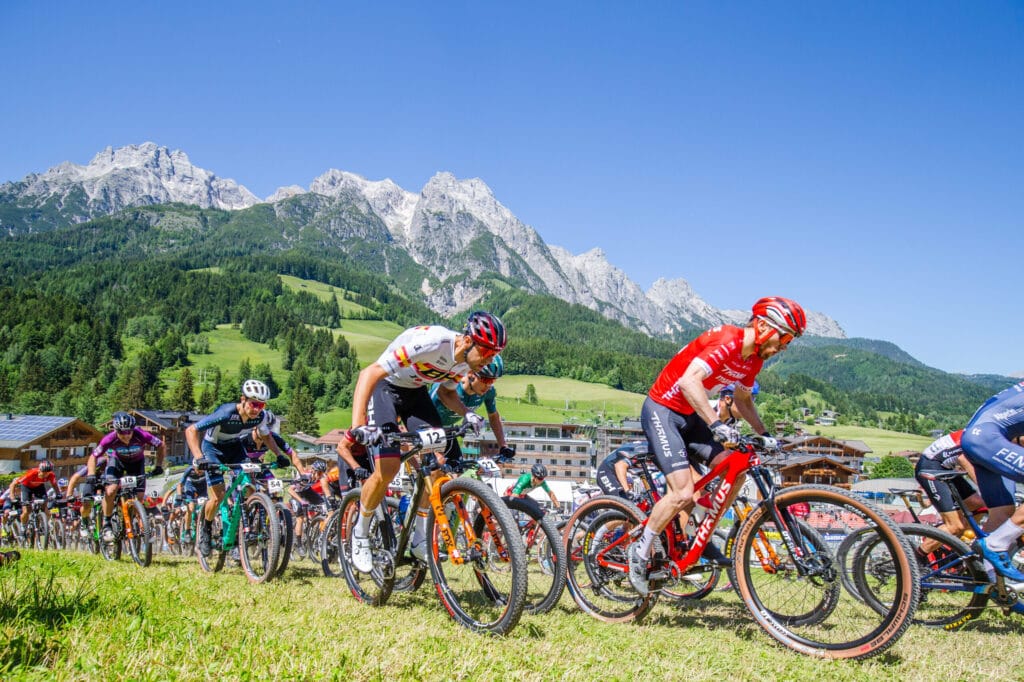
At the same time, mountain biking also has some advantages over roads.
“Mountain biking provides a good balance of training and coordination. In addition, the trails in mountain biking are often more like the type of trails used in cross-country skiing in the winter, and the competition time in mountain biking is more similar to cross-country skiing,” he says.
“But not everyone likes cycling or has suitable equipment. To get sufficient training benefits from cycling, it is important to have a good enough bike that is correctly adjusted,” says Steinar Mundal.
What about spinning?
“Riding a spinning bike is also a good alternative. It can be used as a recovery session or as a second workout for the day for variety, especially in the fall and winter when it is wet and cold outside.”
In short: If you like cycling, feel free to do so as part of a versatile training program during the base training season. But focus on easy sessions on the bike and ride the hard sessions in more specific training forms of exercise.
Subscribe to our newsletter
Most read
-
08.08.2026
-
17.07.2026
-
10.07.2026
-
-
08.07.2026


More Articles
-
Recovery – part 3a: Cold therapy
Do you have the habit of jumping into a lake to cool off after a sweaty run in the summer? Or you run from the sauna into a snowdrift during winter. If you answered yes to either of these, you may have unknowingly been aiding your recovery from workouts.25.08.2026