Silver from across the Atlantic: Ben Ogden and the resurgence of U.S. men’s cross-country skiing
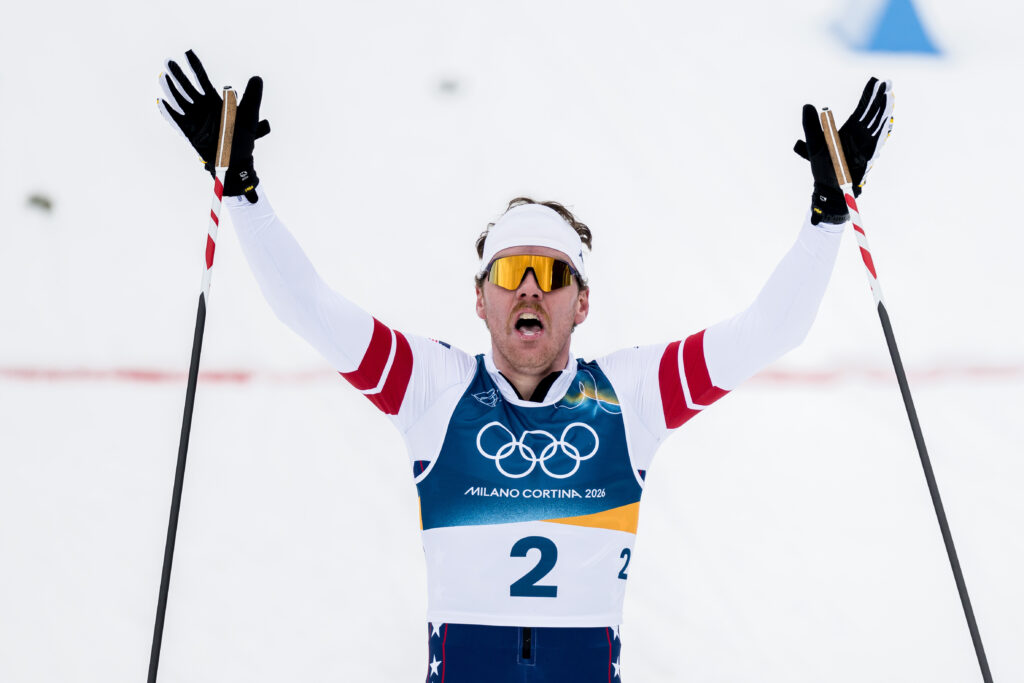
American skier Ben Ogden raced to a silver medal in the classic sprint at the Olympics in Italy: one sentence, one number in the results table, one medal. But the real meaning of this result goes far beyond a simple sporting fact.
In a country where winter is measured by how many schools close and cross-country skiing is an exotic cousin to hockey and alpine skiing; a man has emerged after 50 years who has cracked the doors of the world of traditional cross-country skiing.
This isn’t a quiet comeback. Sprint is today the most visible showcase of cross-country skiing — fast, TV-friendly, dramatic. And classic technique is its most traditional form, a rhythm that feels more like craft than laboratory science. It was in this discipline that Ogden earned silver behind Norway’s Johannes Høsflot Klæbo — the symbol of the modern era — beating a field of Europeans who for generations have treated cross-country skiing as their exclusive heritage.
Also Read: Norwegian superstar powers to sprint gold at Milano-Cortina 2026
A long American silence
When Bill Koch stood on the Olympic podium in 1976, it felt like a fluke — an exception to the rule. The United States had no system, no tradition, and no real belief that it could match Scandinavians, Russians, or Central Europeans. Koch was more of a lone pioneer than a trend starter.
For the next fifty years, U.S. men’s cross-country skiing hovered on the periphery. Names occasionally appeared that hinted at a breakthrough, but none delivered a medal where it really counts — at the Olympics. Meanwhile, the women, led by Jessie Diggins, showed that Americans could excel even in endurance events. But the men stayed the likable outsiders.
Ogden entered this history not as a one-off, but as someone who didn’t want to be an exception — he wanted to be the result of something bigger.
Vermont instead of Trøndelag
Ogden’s background is key to understanding the whole story. Vermont isn’t Norway. It doesn’t have deep forests threaded with tracks, it doesn’t have everyday rituals where skis come out instead of school shoes, and it doesn’t have skiing as part of its identity. Yet there, a small, tough, community-driven ski culture has developed — one inspired by Bill Koch’s legacy and aimed at transplanting European tradition into a place that never had it naturally.
Ogden is the product of that effort: not talent pulled from nowhere, but the result of long work to create conditions where they didn’t naturally exist. In that way, his medal is proof that cross-country skiing isn’t a genetic privilege of the north, but a cultural skill that can be cultivated anywhere.
Sprint as a litmus test
Classic sprint isn’t just a raw speed contest — it’s a game of details: choosing the right track, pole work, shifting weight at the moment the body wants to glide. It’s not laboratory speed skating, but rhythm close to walking uphill — just turned up to the extreme. That’s why Ogden’s success is so telling. He didn’t win through technology, better equipment, or some physiological experiments. He succeeded in a discipline that rewards the fundamentals of skiing — the language Scandinavians know best. Beating them on their terrain means you’ve mastered their own dialect.
Silver that weighs more than the metal
Of course, beating Klæbo was beyond Ogden’s reach — and that’s normal. Klæbo embodies the ideal modern skier, combining sprint explosiveness with tactical assurance. But finishing second isn’t a defeat. It’s a declaration of belonging to the same class. An American who doesn’t adapt his racing to others’ tempo but sets his own is an image the cross-country world will get used to.
Change doesn’t happen through revolutions, but through incremental steps: one final, one podium, and eventually a new mental model — that Americans aren’t just exotic participants, but genuine contenders, according to Bezky.net.
What will be left after the finish line?
The question coaches and officials now ask isn’t whether Ogden is exceptional. It’s whether his journey can be repeated. Whether his path can be transformed into a system or remain a personal story.
In that sense, his silver is like Koch’s bronze — a moment that might mark the beginning, rather than just a memory. But today’s cross-country skiing is more global, more open, and less dependent on national myths. If in 1976 an American had to go to Europe to learn to ski, today Europe looks to America to understand how to grow its sport.
Ogden isn’t just a medalist. He’s a signal — that cross-country skiing will thrive only if it stops acting like a closed club of the north. And that even a classic sprint can be a bridge between tradition and new audiences.
Also Read: Program for cross-country skiing at the Milano-Cortina 2026 Winter Olympics
FACTS 2026 Milano-Cortina Winter Olympic Games – Cross-Country Skiing
- When: Saturday 7, to Sunday, February 22, 2026
- Who: Elite national skiers – women and men
- Where: Val di Fiemme, Italy
- What: Milano-Cortina 2026
Saturday, February 7: 20km Skiathlon C/F Women (More information can be found HERE)
- 13:00 CET: 20km Skiathlon C/F, Women
Sunday, February 8: 20km Skiathlon C/F Men (More information can be found HERE)
- 12:30 CET: 20km Skiathlon C/F, Men
Tuesday, February 10: Sprint C Women and Men (More information can be found HERE)
- 9:15 CET: Sprint Quali C, Women
- 9:55 CET: Sprint Quali C, Men
- 11:45 CET: Sprint Final C, Women
- 12:15 CET: Sprint Final C, Men
Thursday, February 12: 10km Interval Start F Women (More information can be found HERE)
- 13:00 CET: 10km Interval F, Women
Friday, February 13: 10km Interval Start F Men (More information can be found HERE)
- 11:45 CET: 10km Interval F, Men
Saturday, February 14: 4×7.5km Relay C/F Women (More information can be found HERE)
- 12:00 CET: 4×7.5km Relay C/F, Women
Sunday, February 15: 4×7.5km Relay C/F Men (More information can be found HERE)
- 12:00 CET: 4×7.5km Relay C/F, Men
Wednesday, February 18: Team Sprint Women and Men (More information can be found HERE)
- 9:45 CET: Team Sprint F Quali, Women
- 9:45 CET: Team Sprint F Quali, Men
- 11:45 CET: Team Sprint F, Women
- 11:45 CET: Team Sprint F, Men
Saturday, February 21: 50km Mass Start C Men (More information can be found HERE)
- 11:00 CET: 50km Mass Start C, Men
Sunday, February 22: 50km Mass Start C Women (More information can be found HERE)
- 10:00 CET: 50km Mass Start C, Women
Complete program for the Winter Olympic Games can be found HERE
Val di Fiemme, a classic Nordic skiing venue, promises thrilling racing on courses steeped in Olympic history. Fans around the World will have the chance to cheer on athletes across all distances, from explosive sprints to grueling marathons.
Are you interested in traditional cross-country skiing? Click HERE and read more about it.
As a member of ProXCskiing.com, you get full access to all content on the site. Also, live streaming of Ski Classics events with English commentaries is available.
When you become part of one of the World’s leading XC ski communities, you will receive many exclusive offers all year round.

Subscribe to our newsletter
Most read
-
11.05.2026
-
07.05.2026
-
09.05.2026
-
28.09.2026
-
13.09.2026


More Articles
-
The Big Ski Test 2026 – Double Poling Skis
Next up in this year's ski test: double poling skis. We have tested seven pairs from the leading brands to help you find the ski that suits you.22.10.2026