What Makes Klæbo So Exceptional?

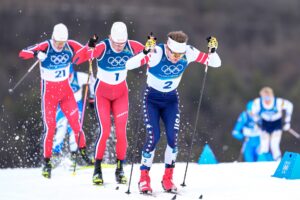
There are four key reasons why the Norwegian cross-country icon dominates sprint racing. Johannes Høsflot Klæbo has a fresh approach to technique.
He has an act for tactical decisions, and physical build that is ideal for modern cross-country skiing. This unique combination has proven unstoppable.
They have identified four key reasons why Klæbo is so extremely efficient.
1. Klæbo represents the pinnacle of modern cross-country skiing
Klæbo belongs to the next generation cross-country skiers, who have grown up with roller skiing arenas. These typically consist of short, steep hills, steep turns and high speed – all of which are ideal for developing a quiver of specific high-speed techniques and adaptation to rapid technique changes.
The latter is particularly crucial: During a sprint heat, racers on average switch between different sub-techniques more than 30 times. During the Olympics, Klæbo was a fast classic skier, but it was at skating he really dominated. His peculiar variety of “hopping V1” is a style worth noting. Additionally, he has an ability to “consume” easier, rolling terrain, similar to what Thomas Alsgaard did at the 1994 Olympics.
2. Klæbo is ahead of the game in course analysis.
For every race, Klæbo breaks down the course and the profile in an almost in a scientific way in order to determine how to race each segment in the fastest possible way.
This was particularly apparent over the last hilltop at the 2018 Olympics in South Korea, where he managed to accelerate from high turnover diagonal striding through a couple of giant, fluid diagonal strides into a powerful double-pole and finally a highly efficient downhill technique. The speed you generate over the crest of a hill is crucial for the speed you are able to go farther down the hill.
This has recently been studied in alpine skiing by researcher from the Norwegian College of Exercise Science (Norges idrettshøgskole): The speed you set from the gate is much more important than previously assumed. Just look at the first couple of skate strides alpine skiers do out of the start.
3. Klæbo has an ideal physical build for modern cross-country skiing
An exceptionally high VO2max has always been a prerequisite for success at the international level. Cross-country skiers are the athletes with the highest VO2max in the world, with most men on the World Cup at 85-90 ml/kg/min.
But sprint races (<1,8 km), where the average speed is about 20 percent higher than for a 15-kilometer event, require incredibly high anaerobic capacity as well. Not just for an occasional surge, but over and over again throughout the race.
These two energy systems – the aerobic and the anaerobic, can be compared to modern hybrid automobile engines: a powerful gasoline engine delivers high power over a long period of time. The electric engine can put out even more power for a short period of time, but equally important is the incredibly fast acceleration of the electric engine. When driving at peak power, the car uses both engines, but when the battery is flat, the car recharges the battery on the next downhill.
Skiers who have a powerful gasoline engine and a large battery with a fast charging solution are the optimal sprint racers. All of the top sprinters have these properties. Klæbo is an extreme version.
4. In classic skiing, Klæbo’s running technique stands out
This technique is obviously effective and fast, but comes at a high cost in terms of energy expense. The unique thing about Klæbo, is that he has buckets of energy (anaerobic capacity) to pull off this challenging technique.
Klæbo’s running technique is not only useful for climbing, but indirectly for descents and flats as well. This technique requires an exceptionally powerful kick, which generates a lot of pressure into the snow, and allows the skier to get away with less kick wax for the climbs. Less kick wax means better glide, particularly on the flats, where more layers can create a drag.
Subscribe to our newsletter
Most read
-
21.02.2026
-
03.12.2021
-
11.05.2026
-
09.05.2026
-
07.05.2026


More Articles
-
Olympic stars tie the knot: she said YES!
Five years after they became a couple, the big news came from the cross-country skiing stars: "It was about time."28.09.2026