The invisible work behind success: Julian Edlinger shares insights and emotions from his role as a service technician
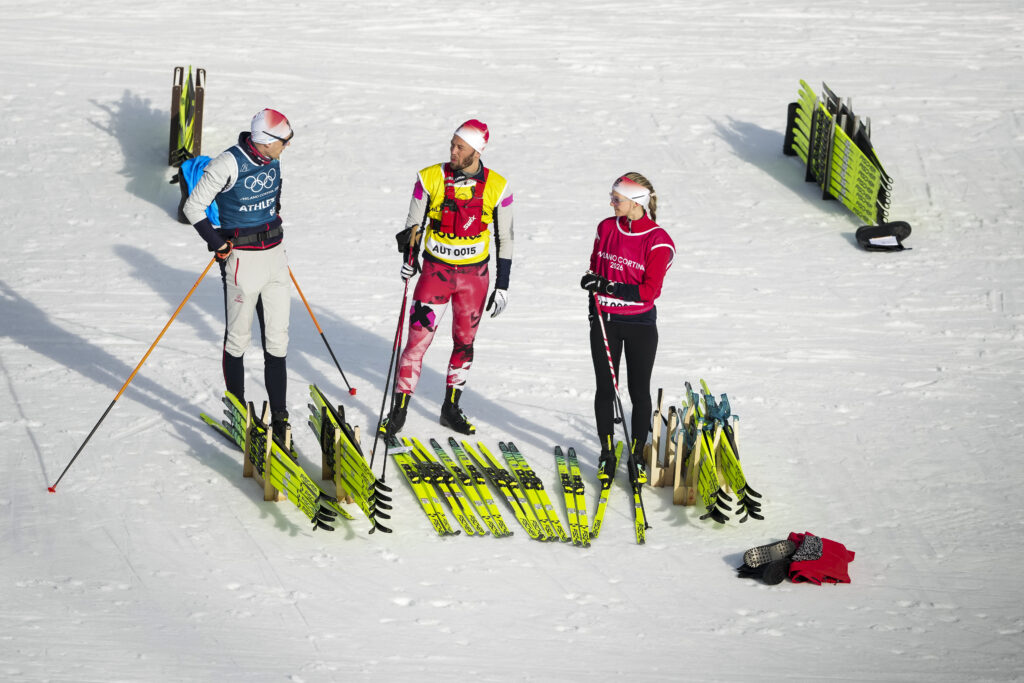
At the Olympic Games, a tenth of a second often separates victory and disappointment. But long before an athlete steps onto the start line, countless days and nights of work have already been done by a different team: the ones who could make the difference behind the scenes.
One of them is Julian Edlinger, a serviceman on Austria’s national cross-country ski team.
Logistics, Wax, and the Battle Against the Weather
Edlinger is a central figure in the technical backbone of the Austrian national team.
“My main task is logistics: where our waxing truck drives, when it leaves, when and where it needs to be,” he explains.
Together with their transport partner DB Schenker, he organizes routes, ferry schedules, and timing — ensuring that everything from a World Cup stop in Scandinavia can be back in Central Europe and ready for use again within just a day or two.
But the planner is also a hands-on expert and a perfectionist on the ski.
Edlinger is primarily responsible for glide waxing, the material that allows the ski to move efficiently over the snow. “Whether it’s powder, liquid wax, or a speed block — I apply it, test it, optimize it, and test again all over again, together with my colleagues,” he says.
Since the global fluorine ban, the job has become much more demanding:
“In the past, we had three or four products that we knew worked. Now the options are enormous. We always say: testing once is like not testing at all.”
At the team’s preparation camp in Muonio, Finland, the service crew conducted nine waxing sessions per day — that’s nine sets of eight pairs of skis, which means around 50 test kilometers daily for him. “We ski more than some athletes do in training,” he jokes.
From Biathlon Back to His Roots
Before joining the cross-country service team, Edlinger worked for five years in the biathlon World Cup as a service guy. “I learned so much during that time and met amazing people.” Then he got an offer from Alois Stadlober, Austria’s national cross-country ski manager, who asked if Edlinger would take over the waxing crew.
“I needed a few days to think about it, but since I came from cross-country skiing myself — I went to the skiing academy in Eisenerz — it felt like returning to my roots. I took the job, and I’ve never regretted it.”
Life at the Olympics
The Olympic Games are a test of endurance even for those not competing. For three weeks, the service team has been working without proper days off. “Luckily, most races start around midday, so we can at least sleep a little,” Edlinger says. Days begin around 7:30 a.m. At the stadium, it’s organized work: selecting skis based on snow type, applying wax, testing glide, adjusting structures. “Depending on temperature, snow type, and humidity, we prepare and test different setups,” he explains. Lunch usually consists of a quick break between test runs, followed by more testing in the afternoon. “After dinner, we usually go to the sauna as a team, that’s our mental reset.”
Finding balance is essential in a job that constantly pushes physical and mental limits, Edlinger emphasizes. Whether it’s playing video games, taking an evening walk, or sharing a drink with friends after a long day, each team member has their own way of switching off. Without balance, it’s nearly impossible to keep this up over a longer period.” And adds “The days are long, but everyone here works toward the same goal, helping Austria chase medals.”
Between Pressure and Routine
Edlinger knows well that his work can directly influence a race result. “There’s pressure, of course, but experience brings calm. But even with routine, there’s always room for doubt, he admits. “Pride and self-doubt go hand in hand. Only those who question things will keep testing new stuff and get better.” That mindset was crucial when the fluorine ban changed the sport overnight. “At first, it was like jumping into cold water. From one day to the next, all our products were different. We had to rebuild trust in the materials.” He remembers that first post-ban World Cup vividly: “In Ruka, I was so nervous. You stand there next to the big nations, Norway, Sweden, and you’re not sure if you’ve nailed it. You just hope everything works.”
When Instinct is more important than Structure
Behind finding the perfect glide lies a lot of structure, but sometimes, intuition makes the real difference. All test data, every combination of base structure, temperature, snow type, wax, etc., is documented. “Ideally, we build a kind of pyramidsystem of tests days before a race so we can narrow down to the best possible variant,” he says. “But that only works if the weather stays stable.” When it changes suddenly, there’s no time left for testing. “Then experience and gut feeling take over. Sometimes a good memory helps too — you remember similar conditions from a race two years ago and use the same setup because you know it worked that time.”
Trust and Honesty as a Key to Progress
In elite sport, trust between athletes and the service team is everything.
“It has to be 100 percent right,” says Edlinger. “If the serviceman doesn’t trust the athlete or vice versa, friction develops. Honesty is key — only then can both sides improve.”
His favorite feedback? “When an athlete says, ‘I had rockets under my feet today.’ That’s the best reward after intense days of good work before“. Negative feedback isn’t discouraging, either. “If an athlete gives honest feedback and can tell whether it was a material issue or just a bad physical day, that helps us improve. Both types of feedback move us forward.”
Small Nation, Big Results
In the World Cup, Austria’s waxing crew consists of six technicians, and seven at the Olympics — compared to twelve for Norway. “The big nations can therefore simply test more, but we make up for it with efficiency and passion,” says Edlinger.
“We’ve had three different athletes on the podium this year. That’s the result of thousands of hours of testing and real team spirit.” Austria’s strategy is clear: work hard and efficiently and “if something didn’t work well, we analyze it and try to do better next time.”
What Fans Don’t See
On TV, fans see the winners and losers, the skis that glide well or less well compared to other nations. But the unseen reality is the work behind a ski. “If there’s a race on Friday, normally we start testing by Wednesday, dozens of skis, endless waxes, countless kilometers,” Edlinger says. “Most people never realize how much money, material, and time go into preparation before an athlete even clips into a single pair of ski bindings.” He wishes effort were appreciated more, not just by experts, but also by fans at home, analyzing split times and ski quality. He opens, also from athletes: “A simple ‘thank you for the work’ means a lot. Even after a bad race, because in every ski, regardless of the result, there’s the same amount of effort and care.”
Passion as Motivation
Why does someone take on such long nights and cold mornings for no public applause?
“It’s the team,” Edlinger answers immediately. “You share wins and losses, travel together, see new countries, and meet amazing people, which binds you together and gives you new friends.” He loves the atmosphere at major events. “Sure, it’s hardcore to go out at 3 a.m. to test skis, but when your athlete delivers a great performance, everything is worth it.” And above all: “I get to turn my hobby into my job. Others sit in offices all day; I get to be outside, in the snow, doing what I love most – cross-country skiing. That’s the best thing in the world.”
As the exhausting Olympic weeks near their end, the service crew prepares for one final highlight: the women’s 50km mass start tomorrow at 10:00 CET. Austria’s Teresa Stadlober will be among the top favorites.
FACTS 2026 Milano-Cortina Winter Olympic Games – Cross-Country Skiing
- When: Saturday 7, to Sunday, February 22, 2026
- Who: Elite national skiers – women and men
- Where: Val di Fiemme, Italy
- What: Milano-Cortina 2026
Saturday, February 7: 20km Skiathlon C/F Women (More information can be found HERE)
- 13:00 CET: 20km Skiathlon C/F, Women
Sunday, February 8: 20km Skiathlon C/F Men (More information can be found HERE)
- 12:30 CET: 20km Skiathlon C/F, Men
Tuesday, February 10: Sprint C Women and Men (More information can be found HERE)
- 9:15 CET: Sprint Quali C, Women
- 9:55 CET: Sprint Quali C, Men
- 11:45 CET: Sprint Final C, Women
- 12:15 CET: Sprint Final C, Men
Thursday, February 12: 10km Interval Start F Women (More information can be found HERE)
- 13:00 CET: 10km Interval F, Women
Friday, February 13: 10km Interval Start F Men (More information can be found HERE)
- 11:45 CET: 10km Interval F, Men
Saturday, February 14: 4×7.5km Relay C/F Women (More information can be found HERE)
- 12:00 CET: 4×7.5km Relay C/F, Women
Sunday, February 15: 4×7.5km Relay C/F Men (More information can be found HERE)
- 12:00 CET: 4×7.5km Relay C/F, Men
Wednesday, February 18: Team Sprint Women and Men (More information can be found HERE)
- 9:45 CET: Team Sprint F Quali, Women
- 9:45 CET: Team Sprint F Quali, Men
- 11:45 CET: Team Sprint F, Women
- 11:45 CET: Team Sprint F, Men
Saturday, February 21: 50km Mass Start C Men (More information can be found HERE)
- 11:00 CET: 50km Mass Start C, Men
Sunday, February 22: 50km Mass Start C Women (More information can be found HERE)
- 10:00 CET: 50km Mass Start C, Women
Complete program for the Winter Olympic Games can be found HERE
Val di Fiemme, a classic Nordic skiing venue, promises thrilling racing on courses steeped in Olympic history. Fans around the World will have the chance to cheer on athletes across all distances, from explosive sprints to grueling marathons.
Are you interested in traditional cross-country skiing? Click HERE and read more about it.
As a member of ProXCskiing.com, you get full access to all content on the site. Also, live streaming of Ski Classics events with English commentaries is available.
When you become part of one of the World’s leading XC ski communities, you will receive many exclusive offers all year round.

Subscribe to our newsletter
Most read
-
11.05.2026
-
07.05.2026
-
09.05.2026
-
28.09.2026
-
13.09.2026
More Articles
-
Anger reflects on Olympic nightmare: “My goal is an individual World Championship medal”
Last winter started as a dream but turned into a nightmare. Now, Edvin Anger has recharged ahead of the World Championships in Falun, with individual medals as the goal.17.10.2026