From circuit training to real strength for the ski tracks
Circuit training is a solid foundation for recreational skiers, but progress eventually requires more. This article explores how bodyweight and sport-specific strength training can take skiing performance to the next level, without the need for a gym.
For recreational cross-country skiers, circuit training has long been a natural way to build muscle fitness. It is easy to do at home, at the cabin, or alongside endurance workouts, and it requires no special equipment. For many, it is also the first step toward more structured training. Still, at some point, many notice that progress stalls: the legs no longer hold in climbs, double poling fades, and speed drops during long efforts.
At this point, it makes sense to turn attention toward strength training. This does not automatically mean heading to the gym. Strength can be developed effectively using only bodyweight, as long as the training is designed to support skiing performance.
Read also: Stabilization exercises for skiers: Mobile and strong core
Transfer happens in an upright position
In cross-country skiing, everything happens in an upright position: balance, force production, and rhythm. That is why strength training should also take place in a similar position. If most exercises are done lying down or sitting, the body may get stronger, but the transfer to skiing performance often remains limited.
When movements are performed standing, preferably on one leg or with active body control, balance and coordination are automatically involved. These are exactly the qualities needed on the track. At the same time, the nervous system learns to produce force in the right direction—the one that propels the skier forward.
The benefits and limits of circuit training
Circuit training is not a bad training method. It effectively develops muscular endurance and works especially well as a foundation, particularly for beginners. Problems arise only when the same light load is repeated year after year without progression.
When resistance remains low, training starts to resemble endurance work rather than true strength training. In that case, the muscles’ ability to produce force no longer improves, even if the session feels tough and sweat is flowing.
The solution is not to abandon circuit training, but to evolve it. Exercises can be made more demanding, tempo can be slowed down, and single-leg as well as explosive movements can be added. This way, bodyweight training becomes significantly more effective and more supportive of skiing performance.
Sport-specific strength comes from movement
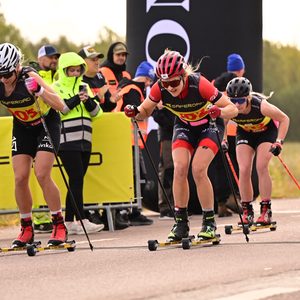
One of the most underestimated ways to build strength for skiing is to train it directly through the sport itself. Roller skiing offers an excellent opportunity for this during the snow-free season.
Skating without poles effectively develops leg strength and balance. Double poling, in turn, strengthens the upper body and core control in a way that is difficult to replicate with other exercises. Adding uphill efforts introduces natural resistance that challenges the muscles far more than flat terrain training.
This kind of sport-specific strength work is often far more effective than separate “strength endurance” sessions, because the movement patterns, muscle activation, and timing directly match the demands of skiing.
Bodyweight training works—when done right
A gym is not a requirement for developing strength. You can go a long way using your own bodyweight, as long as the training is varied and progressive. The key is to make the exercises sufficiently challenging.
In practice, this means progressing from two-leg squats to single-leg variations, and from basic push-ups to more demanding versions. Controlled tempo increases the load without added weights, while jumps and bounds bring in an element of explosive strength.
Recovery also plays an important role. Strength training is not continuous effort; proper rest between sets is necessary to ensure that each repetition is performed with quality.
Small changes, big impact
Many recreational skiers think that strength training requires major lifestyle changes. In reality, just one or two well-structured sessions per week can lead to significant improvements. When exercises are chosen wisely and training supports skiing, the results quickly become visible. The kick becomes sharper, double poling more efficient, and fatigue is pushed further away.
Strength is not just a quality for elite skiers. It is a key component of performance for recreational skiers as well, and at its best, it makes skiing not only faster but also feel easier.
The article continues below.

Examples of effective training sessions
A basic bodyweight strength session can be performed as two to four rounds, with about one to two minutes of rest between rounds. Suitable exercises include forward lunges with 10–12 repetitions per leg, single-leg squats to a bench with 6–10 repetitions per leg, push-ups and pull-ups with 5–20 repetitions, a plank with alternating hand touches for 30–45 seconds, back extensions with 15–20 repetitions, and squat jumps with 8–12 repetitions.
A skier-specific circuit can be done for three to five rounds, with 40 seconds of work and 20 seconds of rest per exercise. Movements can include side-to-side skating jumps without poles, standing double poling with a resistance band, lunges combined with upper body rotation, push-ups with shoulder taps, standing core crunches bringing knee to elbow, and fast footwork in place as a light interval.
An uphill strength workout on roller skis is simple but highly effective. The session consists of six to ten uphill efforts lasting 30–60 seconds, performed either without poles or using double poling. Recovery is done by rolling back down to the starting point.
For more advanced skiers, a strength session can be structured with three sets per exercise and about 1.5–2 minutes of rest between sets. The workout may include Bulgarian split squats with eight repetitions per leg, single-leg deadlifts, explosive squat jumps, narrow push-ups, and a dynamic plank.
Strength training does not require perfection, but it does require purpose. When training supports skiing, every stride and pole push becomes more effective and efficient.
Are you interested in training for long-distance and traditional cross-country skiing? Click HERE and read more about it.
Subscribe to our newsletter
Most read
-
21.09.2026
-
14.09.2026
-
-
06.08.2026
-
06.03.2026



More Articles
-
It’s official: Olympic champion Jacquelin skips the biathlon season for cycling
Emilien Jacquelin has confirmed what many had expected for weeks. The French biathlete will not race the 2026/2027 season and will instead keep chasing his dream on the bike.22.09.2026