Faster recovery on hot days: discover manual lymphatic drainage
Do you suffer from swollen ankles on hot days, or are you looking for a way to significantly speed up recovery after sports? The key to a healthier body lies in proper lymphatic flow. Explore how manual lymphatic drainage differs from regular massage.
Lymph is a clear fluid that flows through a complex system of lymphatic vessels and nodes within the human body, originating from tissue fluid. Its function, simply put, is to maintain and support the body’s defense, transport, and drainage processes. It actively participates in the immune system and requires regular care.
Manual lymphatic drainage (MLD) is a procedure consisting of very light and precisely performed touches that differ significantly from classical and sports massage in terms of depth and pressure. During MLD, we primarily work on the surface of the skin and subcutaneous tissue, rather than deeply with the muscles. No oil is used; instead, powder is applied, as we want to move with the skin, not glide over it.
Moreover, MLD should never be painful. Lymphatic tissue is very easily disrupted; if MLD is performed incorrectly—such as with too much pressure, pointwise instead of broadly, or against the direction of lymph flow—it can lead to irreversible changes and unpleasant health consequences.
What MLD involves
I recommend my clients undergo MLD in several sessions, divided into treatments for individual body parts, and only then proceed to a full-body MLD; this is the only way to achieve the desired effect.
It is always necessary to reserve at least 2–2.5 hours (for a full-body MLD, a minimum of 3 hours). After MLD, it is advisable to avoid increased physical activity, saunas, and to replenish fluids for at least 24 hours—MLD supports lymph flow, thereby increasing the rate of drainage.
If you book an MLD session, ensure a thorough assessment of your health status, as there are many contraindications where this technique is not suitable.
Why undergo MLD
If you suffer from various types of swelling not only in the lower limbs (e.g., after exercising or standing all day at work), in the face, feel “puffy,” have been diagnosed with lymph- or lip-edema and have a tendency for their occurrence, want to get rid of cellulite, or simply wish to detox your entire body, definitely try this very pleasant and soothing therapy.
The importance of MLD for athletes
Both those who appreciate relief from the effects of prolonged hot weather in summer and athletes who benefit from the strong recovery effect of the procedure throughout the year regularly attend MLD sessions.
During physical activity, blood, and thus lymph, tends to remain in the peripheral parts of the body, slowing down their circulation. Fluid accumulates and exerts pressure on surrounding tissue, leading to feelings of heavy legs or visible swelling, most commonly in the fingers or around the ankles and feet.
When lymph and blood flow properly and are not retained anywhere, metabolic waste can reach the appropriate lymph nodes, where they are captured and eliminated. Otherwise, recovery time and necessary training can be significantly prolonged.
MLD also accelerates recovery after injuries and post-operative conditions, such as a ligament rupture in the ankle or knee, and the subsequent, long-lasting unpleasant swelling. After a visit to the therapist, we observe accelerated healing characterized by a reduction in the aforementioned swelling and surrounding hematoma.
Lymphotaping and its functions
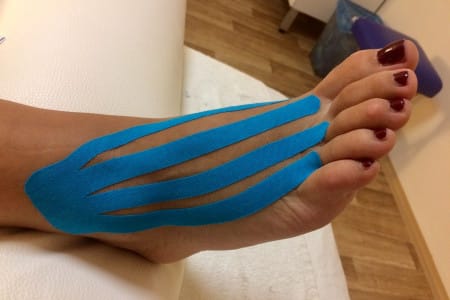
There is also a way to enhance the effect of MLD even further through breathing exercises to activate the deep lymphatic system, as well as using lymphotapes, which reduce tension by lifting surface tissues and direct lymph flow towards the lymph nodes. A special herbal tea is also recommended.
Lymphotapes look different from classic kinesiology tapes; they are often cut into smaller strips resembling octopus tentacles and are applied in waves or grids made from two or more kinesiology tapes layered over each other.
In addition to manual techniques, machine-assisted lymphatic drainage is often offered, but its results depend heavily on the number of chambers in the sleeves and cuffs, the pressure within them, and the duration of use, and it is never as thorough as manual drainage.

This article has been updated. It was first published on Bezky.net in September 2021.
Also Read: Recovery is a crucial part of training
Are you interested in training for Ski Classics, long-distance, traditional cross-country skiing, and biathlon? Click HERE and read more about it.
Subscribe to our newsletter
Most read
-
28.08.2026
-
-
14.09.2026
-
06.08.2026
-
06.03.2026



More Articles
-
Tour of Slovakia stage 4: One day without hills
On paper, the 197,5km from Beluša to Galanta is the easiest of this year’s Tour of Slovakia.19.09.2026