CYCLING TRAINING: Easy aerobic ride – building your base one hour at a time
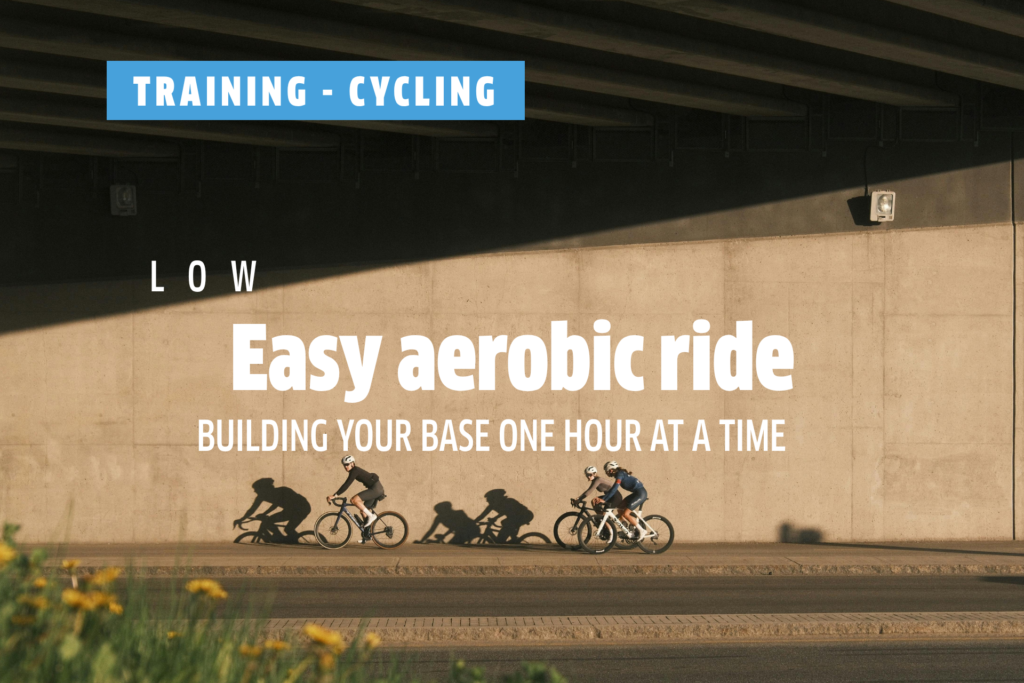
The foundation of cross-country ski fitness is built in the quiet hours of low-intensity training. This easy aerobic ride delivers exactly that: steady, controlled work that develops your engine without leaving you depleted for tomorrow’s session.
Session facts
| Type | Endurance |
| Duration | 90–120 min |
| Intensity | Low (Z1–Z2) |
| RPE | 2–3 out of 10 |
| Terrain | Flat to rolling |
| Structure | Warm-up / Main session / Cooldown |
| Frequency | 1–2 times per week |
Training effect
This session develops aerobic capacity and fat oxidation, two pillars of endurance performance that translate directly to the long climbs and sustained efforts of cross-country skiing. Riding at a controlled low intensity trains your cardiovascular system to deliver oxygen efficiently, builds mitochondrial density in the working muscles, and promotes recovery between harder sessions. Done consistently throughout the off-season, it forms the base on which everything else is built.
Warm-up — 15 min
- Start at a very relaxed pace, legs spinning freely
- Gradually bring your heart rate up into the lower end of Z2 by the end of the warm-up
- Focus on smooth, relaxed pedaling — no pushing yet
Main session — 60–90 min
- Ride at a steady, comfortable pace in Z1–Z2 throughout
- You should be able to hold a full conversation at all times — if you can’t, ease off
- Keep cadence relatively high (80–90 rpm if you have a cadence sensor; otherwise aim for a brisk, light spin rather than a heavy grind)
- On any hills, shift down and maintain the same low effort — do not let your heart rate climb into Z3
- Use this time to work on riding efficiency: relaxed grip, quiet upper body, smooth pedal stroke
Cooldown — 10–15 min
- Gradually reduce pace over the final 10–15 minutes
- Finish with 5 minutes of easy stretching: hip flexors, quads, hamstrings and lower back
Note: For cross-country skiers, the temptation is always to go harder than necessary on easy days. Resist it. This session is specifically designed to build aerobic capacity and fat oxidation, two pillars of endurance skiing performance, while keeping your legs fresh for the quality sessions that matter most. Do this once or twice a week throughout the off-season, and your base will show up in the snow.
Also Read: Cycling for skiers: A valuable tool for summer training
Are you interested in training for Ski Classics, long-distance, traditional cross-country skiing, and biathlon? Click HERE and read more about it.
Subscribe to our newsletter
Most read
-
-
14.09.2026
-
06.03.2026
-
16.09.2026
-



More Articles
-
Team BSV IBEX — Pro Team presentation Season XVIII
Switzerland's first and leading Pro Team enters Season XVIII with a reshaped roster, headlined by a major international signing.13.10.2026