How the fluor testing will work during Friday’s World Cup premiere?

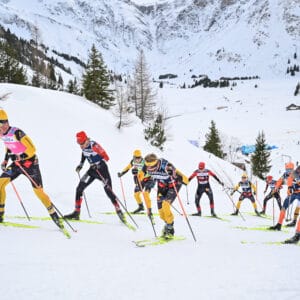
Classic sprint is the opening event in this winter’s World Cup. Sprint in classic style has long been the waxers’ most intense day. Now, in addition, tests are being conducted due to the fluor ban. Here, the new Swedish waxing manager Anders Svanebo explains all the fluor tests that will take place during the World Cup sprint days.
A few months ago, Anders Svanebo took over as the new waxing manager for the Swedish national team. On Friday, the real deal begins; this year’s World Cup season starts in Ruka, Finland:
“It feels incredibly fun and exciting that it’s finally starting,” says Svanebo.
The waxing conditions are entirely new for this season due to the fluor ban. What has this meant for your preparations?
“We have done incredibly thorough testing and had close cooperation with the Swedish Olympic Committee and the Swedish Biathlon Federation. We are well-prepared for what lies ahead. It’s also true that, for this season, we have had to start ‘in an entirely new book’ regarding experiences since fluor waxes have been banned. So, we have started writing the first lines in our new book,” says Svanebo to Langd.se.
The first event in the World Cup is the classic-style sprint in Ruka, Finland.
The fluor ban naturally applies to all distances and competitions, but what is specific to the sprint is that the athletes who make it all the way to the final will start (and finish) four times during the competition day.

This means that an extremely high number of tests will be conducted during the sprint days.
Read More: The Fluor Ban: We will only have “green skis”
So, what does a sprint day look like?
“There has been a change in our preparations. Given that each athlete’s skis must be fluor-tested by FIS half an hour before the start, the athletes must be at the arena 30 minutes earlier than they were last season if they want the same time for warm-up and preparations. This is so that we, together with the athletes, can perform the tests we want to choose the right skis and waxing. Before we start waxing the skis, we conduct our own fluor tests in the equipment in the waxing truck, and then we do the same test after we have waxed the skis for the competition. All to ensure ‘green’ skis,” says Svanebo.
Thirty minutes before the prologue, FIS tests the skis that each athlete will use. Here, the athlete can test two pairs of skis. This takes place in zone 1.
In zone 2 at the start, the skis are picked up by the athlete.
When it comes to the classic style, as in Friday’s sprint, there is also a zone 3 “kick wax zone.” Here, a waxer can apply or “improve the grip.” There is a clear regulation regarding the type of equipment that can be used. It involves waxing tables, wax profiles, battery-powered hot air guns, scrapers, and waxing cork. Only grip wax products are allowed here.
The glide zones of the ski must not be touched:
“FIS will have inspectors on site. It will be important that we have a clear plan beforehand; if we see that snow can come in or there’s a weather change, we need to be prepared, for example, by having a pair of ‘rough skis’ among the two pairs you tested for the prologue,” says Svanebo.
Then the athlete does their prologue, and after finishing the prologue, a new fluor test is done on the skis.
For the athletes who advance to the quarterfinals, there is then a break of about 1.5 hours before the quarterfinals begin.
“During that period, we have the opportunity to conduct new tests and wax the skis again. 15 minutes before the quarterfinals, all athletes must have tested the two pairs of skis to be used in all heats (however, this does not have to be the same pair of skis used in the prologue). And if two pairs of skis are tested in, both pairs must be ‘green,’ i.e., fluor-free. If one of the pairs shows red, it means NPS (not permitted to start), meaning the athlete cannot start in the heat,” says Svanebo.
Can you change skis between different heats?
“You can ski the quarterfinals on ‘pair 1,’ the semifinals on ‘pair 2,’ and the final on ‘pair 1.’ But you cannot use any other pair than the two you chose to fluor test before the heats,” says Svanebo.
After finishing the athlete’s last heat (depending on how far the athlete progresses in the sprint stages), a new fluor test is performed.
Now, the weather expected in Ruka on Friday is cold and dry, and there’s also a “short skiing time.” But how do you think the skiing times on the longer distances will be affected by the fact that there is now a fluor ban in weather where fluor has been favorable before, like wet and warm temperatures?
“We have seen tests that show a difference of 4-5 minutes at most in certain conditions. So, I think we will see 50km races with winning times up to 2:30 again,” says Svanebo.
Subscribe to our newsletter
Most read
-
11.05.2026
-
07.05.2026
-
09.05.2026
-
28.09.2026
-
13.09.2026


More Articles
-
Anger reflects on Olympic nightmare: “My goal is an individual World Championship medal”
Last winter started as a dream but turned into a nightmare. Now, Edvin Anger has recharged ahead of the World Championships in Falun, with individual medals as the goal.17.10.2026