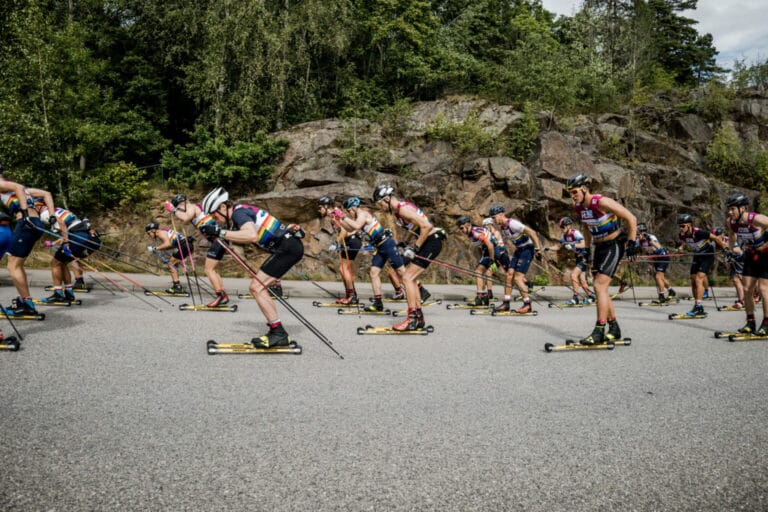
The challenge of uneven wheel resistance in roller skiing

Roller skiing has long faced a significant issue: the resistance of ski wheels varies. Now, students at Chalmers University have developed a measuring instrument to standardize wheel resistance, aiming to make the sport fairer.
As written at Langd.se, for years, roller skiing has struggled with wheels that roll at different resistance levels. Starting this year, the Swedish Ski Federation will base its official guidelines for recommended wheels on the students’ measurement method. The problem is not new, but no official standard for the rolling resistance of wheels used in competitions has existed.
A few years ago, the Swedish Ski Federation introduced a recommendation stating that the wheels’ resistance should correspond to the friction of cross-country skis on snow. This led to the introduction of “standard wheels 2.”
However, there were no regulations defining how easily these wheels should roll. As a result, many different wheels labeled as “standard wheels 2” varied significantly in resistance, leading to unfair racing conditions.
Time Differences Can Be Significant
Andreas Löfgren, a student at the Department of Microtechnology and Nanoscience at Chalmers, along with three classmates, has developed a measuring method and instrument to provide the sport with a reliable and user-friendly solution. This aims to create fairer competition conditions.
“When we analyzed field data from participants in the 2024 Junior Swedish Championships in roller biathlon, we saw that those using the slowest wheels theoretically lost over three minutes compared to equally strong skiers using the fastest wheels. Such a large difference is decisive for final placements. The winner finished in just under 28 minutes, while a skier finishing three minutes later placed eighth,” says Andreas Löfgren. He developed the method alongside Albert Hansson, Arvid Sandström, Jonatan Larsen, and their supervisor, Dan Kuylenstierna, Associate Professor in Microwave Electronics at Chalmers.
Half of the Tested Wheels Fell Outside the Approved Range
Together with the Swedish Ski Federation, the Chalmers students used the new measurement instrument to test the resistance of the most common standard wheels. They collected data to establish what constitutes “normal rolling resistance” and analyzed the variation between different manufacturers.
Based on the test results and statistical analysis, new guidelines have been developed to determine which wheels qualify as having “standard rolling resistance.”
“This allowed us to see just how significant the variation is. We tested twelve different wheels, and half of them fell outside the approved range. Three had too much resistance, and three rolled too easily,” says Dan Kuylenstierna, who supervised the students.
Dan, who has a strong interest in roller skiing, conceived the idea for the measuring instrument after a conversation with one of Sweden’s most accomplished roller skiers, Tobias Westman. Westman, who runs a ski shop in Gothenburg, has encountered many customers struggling to choose the right roller skis.
“Tobias, who has gold medals from both the Swedish and World Championships, told me about the daily challenges customers face with wheels that roll at different resistance levels. That conversation sparked the idea to develop a new measurement method to standardize resistance,” says Dan Kuylenstierna.
New Approved Wheel List for Roller Skiing
Based on the test results, a list of approved wheels for competition has now been established, along with new guidelines that the Swedish Ski Federation can present to clubs, event organizers, and roller ski manufacturers.
“This is a major step for us. With standardized rolling resistance, everyone knows that a ‘2’ will roll the same way, regardless of the brand. This makes it easier to compare results and ensures fairer competitions. In the future, we hope to introduce some form of licensing for manufacturers producing compliant wheels. Our long-term vision is to implement this method internationally, and the project has already attracted interest from the International Ski Federation (FIS),” says Ludvig Remb, competition coordinator for cross-country and roller skiing at the Swedish Ski Federation.
Are you interested in Nordic and roller skiing equipment? Click HERE and read more about it.
Subscribe to our newsletter
Most read
-
03.08.2026
-
26.07.2026
-
28.01.2026
-
27.02.2026
-



More Articles
-
Core strength: the game-changer for skiers
As winter approaches, traditional cross-country skiers, long-distance athletes, and biathletes should pay close attention to one often-overlooked element: the core. A strong core not only supports better skiing techniques but also helps maintain form when fatigue begins to set in.09.09.2026