Training trends: ski sessions inspired by van der Poel, Ingebrigtsen and triathlon

How to get the best out of successful training philosophies from other sports? Here are three ideas for training workouts and strategies adapted for cross-country skiing.
It is often talked about being inspired by other sports and including certain elements adapted to one’s training. But what exactly does that mean, and how do you do it?
Former Norwegian national cross-country skiing coach Geir Endre Rogn, now working as a training consultant through his company Topptrent.com, shares here a three-session plan inspired by the Swedish world record holder in speed skating Nils van der Poel, from triathlon and the Norwegian athletics brothers Ingebrigtsen.
“All sports have their characteristics, and there are good reasons behind the philosophy on which traditional training is based. It would be foolish to ignore years of experience. But the structure of these sessions can be examples of what can inspire and develop cross-country training, without changing too much,” says Rogn to Langrenn.com.
This is the second of two articles on adapting training trends and inspiration from other sports to cross-country skiing.
Previous Article – Training trends: What can cross-country skiers learn from other sports?
Three great workouts inspired by other sports
First up is Nils van der Poel’s standard race preparation session for the speed skating 10.000m event.
“Van der Poel normally skated six times for about four minutes each in this session. It is thus a session at competition speed with a total time that is comparatively a little longer than the competition time of 10.000 meters on skates. To do something similar for a cross-country skiing senior, one should do a couple of extra times, for example, 8×4 minutes. This is a session you do more of towards the competition season, but there can also be elements of it during the summer,” says Rogn.
The second “workout” is the typical Tuesday/Thursday variant from athletics with a double threshold.
“In athletics, it is usually a morning session with 30 to 40 minutes intervals and an afternoon session with intervals or distances of about 20 to 30 minutes. A cross-country skier at the senior level might be able to increase this somewhat, but I wouldn’t invest much more to be ready to train well the next day,” says Rogn.
The third session is a combined workout inspired by the triathlon. The triathletes train a lot at a slow pace and often combine several training activities.
“The triathletes do much the same as many cross-country skiers, so other variants such as long threshold intervals, progressive intervals, or distances can be equally good examples. But it’s important to remember that most of the training is slow, so it’s important to try to get as much as possible out of these sessions as well,” says Rogn.
THIS IS THE TRAINING SESSION
Session 1: 8×4 minutes with 2 minutes rest at 10km pace – inspired by van der Poel
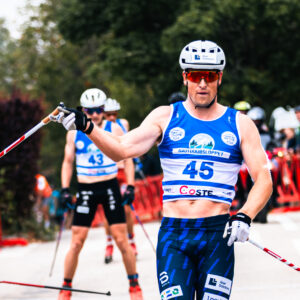
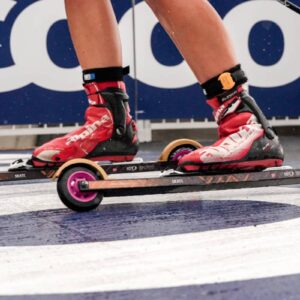
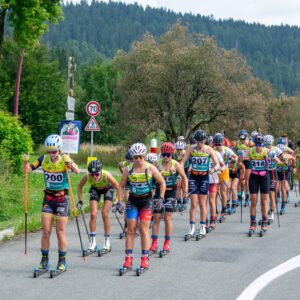
How: Based on van der Poel’s philosophy, this session will be done on the same surface you will be racing. For a cross-country skier, that means on a ski track (or roller skis). Feel free to find a varied course that takes around four minutes. Then you can ensure you can maintain a steady or somewhat progressive speed throughout the session.
This should be a relatively tough session, as the idea is to gain much time at race speed. At the same time, it shouldn’t be an “all out” session to run 4-minute moves at your 10km race pace.
Why: This is based on van der Poel’s typical speed session for 10.000m, where the aim is to get good at staying at the desired race speed. Here you get an excellent endurance session, and you get to practice your technique at precisely the pace you will be competing in. It is reminiscent mainly of typical autumn training for cross-country skiers.
Session 2: Double Threshold – Inspired by athletics
How: Instead of a long threshold session of 45-75 minutes, split the session into a morning and an afternoon session. Then you should have a slightly shorter training time on each session but can also have a somewhat higher speed. There are slightly shorter intervals and frequent breaks or speed variations, which allows you to go at a good pace without the intensity getting too high.
For example, the morning session could be 40 minutes of skiing 30s/30s at speed slightly above and below the threshold speed. Set the watch to beep/vibrate so you don’t have to keep an eye on it.
In the afternoon, for example, you can ski 30 minutes on slightly hilly terrain. You can ski relatively quickly there without your heart rate/intensity exceeding the threshold.
Why: The sum of the day provides a lot of training time at a relatively good pace, but that means you’re still not too tired to get as much out of easy training the next day.
Session 3: Combined session – inspired by triathlon
How: For example, 2 hours of roller skiing and 1 hour of running.
Why: Good and varied cardio training. Combining two activity forms gives you a good long training without as much muscle strain.
Geir Endre Rogn was the coach of the women’s national team for two seasons until May 2020 and of the junior national team for two years before that, and he has eight years behind him as a coach at NTG Geilo. Now Rogn does training consultancy through his company Topptrent.com and follows up with everyone from elite athletes in cross-country skiing, biathlon, and running to younger athletes and fit amateurs.
Subscribe to our newsletter
Most read
-
16.05.2025
-
02.06.2026
-
05.07.2026
-
24.06.2026
-
04.06.2026


More Articles
-
Hedegart: “It will be greater than Olympic golds”
Just three months after returning to biathlon, Einar Hedegart has set a goal he believes will surpass the two Olympic golds he won last winter.27.07.2026