Build your personalized training plan – part 1: Train smart with limited time
Don’t you have much time to train, but still want to give it your best shot? Want to beat a friend or improve your personal best? We all have our own goals while also juggling limited time for preparation. Here, you’ll find tips on how to build a training plan that works for your life.
Designing a training plan for a professional athlete is a science. Improving performance by just one percent can make a huge difference, so every detail must be fine-tuned. The advantage? An elite athlete can dedicate themselves fully to training, recovery, nutrition, and other key areas – seven days a week, around the clock.
For recreational athletes, things are more complicated. Most people have jobs, and sitting at a desk or driving a car doesn’t count as rest. Additionally, many individuals have family responsibilities and other commitments. It’s not uncommon to see parents of young children out skiing or roller skiing in the dark after their kids have gone to bed. Taking a midday nap or resting after lunch is just a distant dream.
Despite all this, ambitions often run high. Some are even willing to push themselves to the limit just to squeeze in a training session. However, that can backfire, resulting in reduced performance. So, planning and executing training for recreational athletes is also a form of science, just with different constraints.
Your background affects your training plan
If you’re targeting a specific race and want to stay fit or improve, aim to train at least three to four times a week. Five sessions are at a solid level, and six are excellent. The fewer sessions you can conduct, the more important quality becomes, always considering your background.
If you’ve been training for years, higher intensity training isn’t a problem. However, if you’re just getting started, endurance should be your top priority – build the habit and gradually condition your body.
What if you can only train twice a week?
If you only have time for two sessions a week, don’t expect miracles. You’ll likely maintain your current performance level, but that’s still valuable. Try to include one longer endurance session, ideally two or preferably three hours long. If you’re confident you can handle it or are up for a challenge, try going for four hours.
To break the monotony, include around 10 short sprints at maximum effort, each lasting 10–20 seconds, to “wake up” the body.
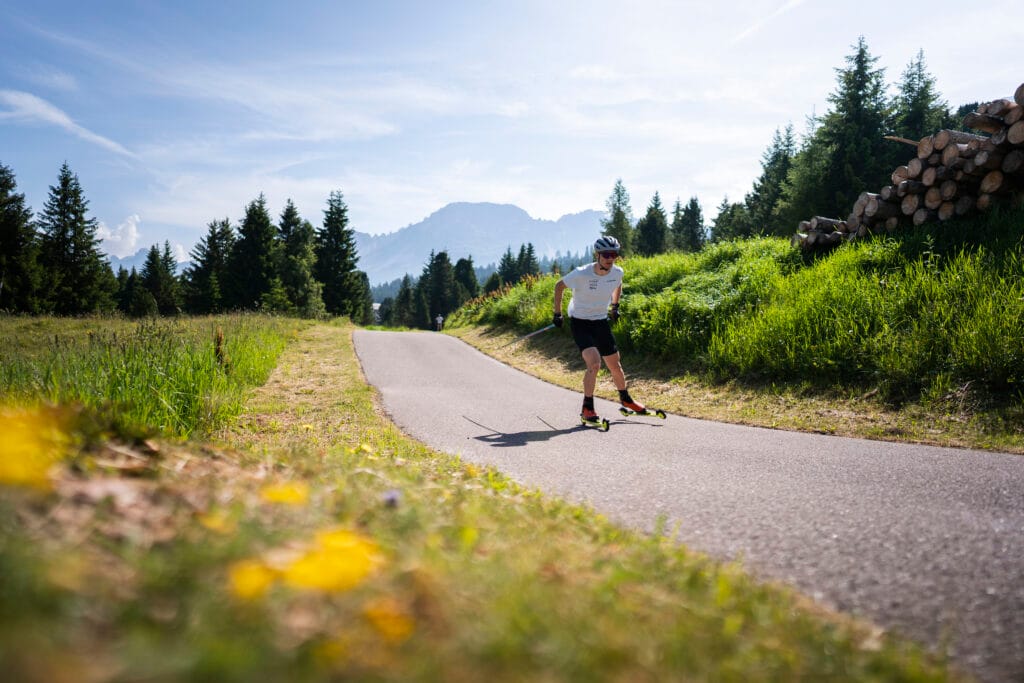
Roller skiing is an excellent way to build full-body strength and prepare for the demands of winter ski races. This longer session should ideally be done on roller skis.
Related Article: Setting SMART goals for the summer training season
And what should your second training session be?
The second session should focus on speed.
This time, lace up your running shoes and head out for a run. You can also use poles (at least 5 cm shorter than your classic ski poles). Plan an interval workout.
Choose the interval length depending on how much you want to challenge yourself. Intervals of 3–8 minutes are common, but you can go longer – just be sure to stay below your anaerobic threshold.
Here are some examples of shorter intervals:
- 6 × 4 minutes
- 4 × 6 minutes
- 8 × 3 minutes
- 5 × 5 minutes
Start each interval with control (below threshold) and gradually increase your speed to reach maximum effort by the end. That’s far better than going out too hard on the first interval and dragging through the rest.
How much rest between intervals?
As a general rule, rest time between intervals should be approximately half the work time. For example:
- For 4-minute intervals: rest for 1.5–2 minutes
- For 6-minute intervals: rest for 2–3 minutes
- And so on
Your recovery ability, or how quickly your heart rate drops between intervals, says a lot about your current fitness. It can also reflect how well you slept or how recovered you are that day.
If you’re running with poles, try finding a long uphill stretch. Running uphill for several minutes will really tap into your energy reserves. It’s a very effective, full-body session that especially targets your lungs and heart, helping to improve your functional capacity.
Read More: Train smarter, not harder: How to optimize your ski training
What about the following week?
Mix things up by going for a longer run – at least an hour or up to two if you can. The second session can be a roller ski workout, approximately 1.5 to 2 hours long, with intervals similar to those from the previous week’s run.
You can do the workout double poling, classic, or skate – it’s entirely up to you. When you’re limited to just two weekly sessions, it’s essential that the training remains enjoyable.
Part 2 coming soon
If you can train more frequently, keep an eye out for Part 2 of our training series, coming soon.
Also Read: Annual training cycle and its planning
Are you interested in training for long-distance and traditional cross-country skiing? Click HERE and read more about it.
Subscribe to our newsletter
Most read
-
21.09.2026
-
14.09.2026
-
-
06.08.2026
-




More Articles
-
It’s official: Olympic champion Jacquelin skips the biathlon season for cycling
Emilien Jacquelin has confirmed what many had expected for weeks. The French biathlete will not race the 2026/2027 season and will instead keep chasing his dream on the bike.22.09.2026