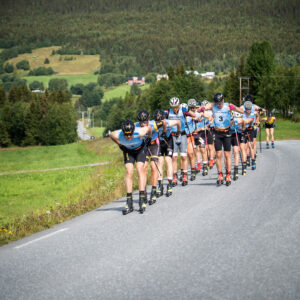
Basic endurance training is the most important work for a skier

The late-season snow is good for developing basic fitness towards the upcoming hard dryland training season. What exactly is basic endurance training, and how did it originate as a training method?
Basic endurance training is a familiar concept to endurance athletes nowadays, but it hasn’t always been so. Ernst van Aaken, a German doctor and coach, is widely recognized as the founder of the LSD training method (distance training) or basic endurance training. In 1969, Joe Henderson, an American runner, coach, and former editor-in-chief of Runner’s World magazine, promoted the LSD method as a running training method. World-famous running coach Arthur Lydiard included “long slow distance training” in his basic principles, and he was the original father of the idea, encouraging running so slowly that you could hold a conversation during the workout.
During the running boom of the 1970s, many recreational runners used this method as the foundation of their training. Gentle basic endurance training naturally suits beginners and recreational skiers, but for more experienced athletes and professional skiers, just easy-paced workouts are not enough, of course. Goal-oriented athletes have to do various intensity workouts, from speed drills to longer intervals and speed endurance training.
Basic endurance training can be diverse, and workouts can vary, which can be easily incorporated into one’s training program. For beginners and recreational athletes, I would recommend long and easy Nordic walking, cycling, or skiing either on snow or on rollers. Nordic walking alone might be a bit dull, so it’s worth going to the forest with a group for a 1-3 hour walk. Uphills and flat terrain can be run if your fitness allows. For beginners, Nordic walking alone in hilly terrain is an effective training method. During aerobic basic endurance training, it’s important to keep the pace comfortably slow so that conversation among the group is possible.
As fitness level increases, you can increase the amount of running. I often use the “run-walk” method in my runs, where running and walking alternate for a certain time, for example, running for 5 minutes and then walking for 5 minutes. I always do these in hilly terrain along the competition tracks in Lahti. Heart rate rises above the aerobic threshold during running intervals but stays well below it while walking. These run-walk workouts nicely extend the duration of the exercise since part of the distance is covered by walking, and the intensity remains much lower than in running alone. For many beginners or recreational athletes, running is too demanding, especially in hilly terrain. Even for experienced recreational athletes, I recommend Nordic walking-running as a long workout, where the walking part is much greater than the running part, and the running parts can be done downhill and partly on flat terrain.
For many professional skiers, very long hikes with a backpack effectively serve as LSD training. Spring and summer are, of course, the perfect time for such workouts. Long-distance skiers ski very long distances on roller skis, and roller skiing is also suitable for experienced recreational skiers. The speed of the wheels should be chosen according to one’s own preferences, and for long distances, fast wheels are a better option if skiing is otherwise safe. With fast wheels, technique remains better, especially in double poling, and heart rates do not rise too high during a long workout. Basic endurance workouts are still a key part of anyone’s training program because building an aerobic base is the foundation upon which speed and interval training can be built.
When the main goal in this “long slow distance training” is duration, training becomes somewhat challenging over time as you reach the point where basic fitness no longer improves. At this point, it’s easy to accumulate so-called “diminishing returns” and “junk miles.” As your experience grows and your aerobic base increases, you can add short sprint sections to your long workouts or short relaxed intervals that don’t accumulate too much lactic acid in your muscles. This way, you can break the monotony of slow workouts and avoid getting stuck. As fitness improves, the pace of basic endurance workouts also increases, so you need to be careful not to inadvertently train at too high intensity.
Basic endurance training is also the cornerstone of training for Ski Classics skiers, but long-distance skiers often include intensity sections in their long workouts. Thus, they become what is called a “Vasaloppet-pass” workout aimed at mimicking the character of the world’s most famous ski race. The term is generic and, of course, comes from Sweden, and each team has its own version of this workout. However, it must be remembered that although this workout is long in duration, it is not a basic endurance workout but a long-duration intensity workout. You can read about Team Ragde Charge’s Vasaloppet-pass from their last autumn training camp in Mallorca.
Subscribe to our newsletter
Most read
-
17.07.2026
-
10.07.2026
-
08.07.2026
-
23.07.2026
-
05.07.2026




More Articles
-
Heggen claims sprint victory at Blink Festival 2026
The Blink Festival 2026 wrapped up in Sandnes on Saturday with fast-paced sprint roller ski races in the city center. In the men’s freestyle sprint, Lars Heggen won decisively.09.08.2026