Nordic walking as ski training – from aerobic base to hill power
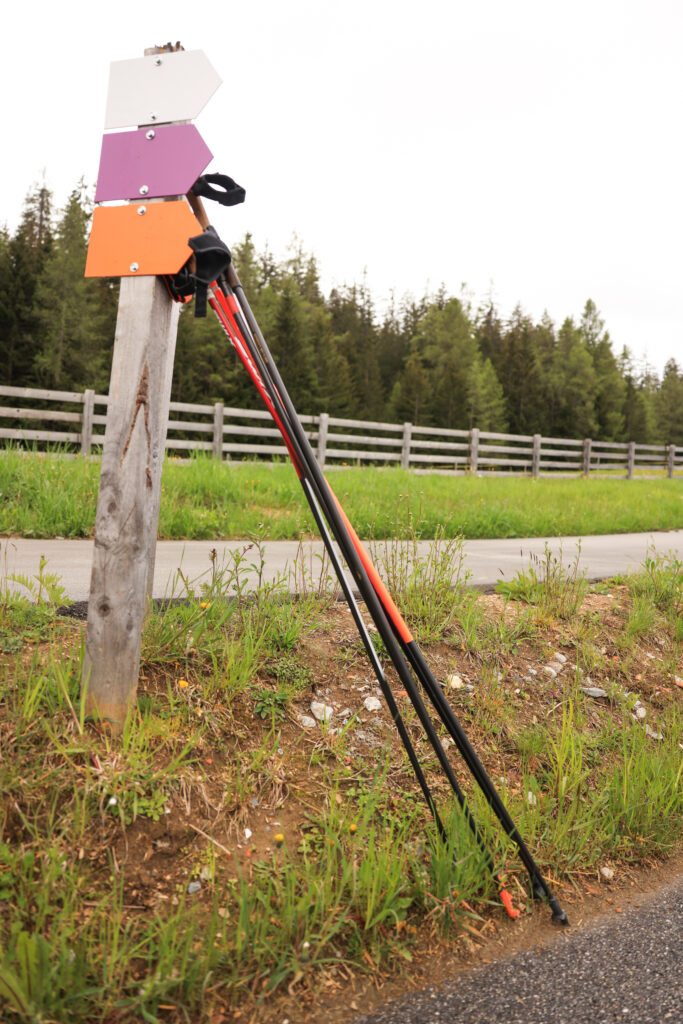
Nordic walking and hill training with poles offer an effective bridge from the ski season to summer training, combining low-impact endurance work with powerful, sport-specific conditioning.
Nordic walking and hill training with poles are excellent forms of exercise during the transition period after the ski season. Especially Nordic walking and pole-assisted running serve as effective yet low-impact aerobic workouts, helping maintain and build fitness without the strain of winter competitions. They provide a natural way to move from skiing into dryland training and are also highly suitable for recreational skiers who want to stay in shape year-round.
Both Nordic walking and hill training with poles are deeply rooted in cross-country skiing traditions. Early on, Finnish skiers realized that skiing movements could be imitated in snow-free conditions by using poles. This was not only a way to maintain technique but also an efficient method to develop physical performance throughout the year.
Using poles added a new dimension to training: in addition to the lower body, the upper body became actively engaged. This turned simple walking or running into a full-body exercise, simultaneously improving endurance, strength, and coordination.
Read also: Biggest summer training mistakes recreational skiers make
Nordic walking – a full-body aerobic workout
Today, Nordic walking is widely recognized as a versatile fitness activity suitable for a broad range of people. Its core idea is simple: the poles create rhythm and activate the upper body, increasing energy expenditure and improving posture.
When performed correctly, Nordic walking distributes the workload evenly across the body without placing excessive stress on the joints. This makes it ideal for beginners as well as more experienced exercisers. At the same time, it provides an excellent foundation for more demanding training methods such as hill workouts with poles.
Hill training with poles – power from the uphill
Hill training with poles is one of the most important dryland training methods for skiers. It involves moving uphill using poles actively, which significantly increases the intensity of the workout. The incline naturally forces the body to work harder, while the poles enable a powerful pushing motion that closely resembles skiing.
The intensity of the workout depends greatly on how it is performed. When done at a steady walking pace, hill training develops aerobic endurance. However, when the uphill sections are run with poles, the session quickly becomes a high-intensity interval workout. In this case, heart rate rises sharply, and the training effectively improves both aerobic capacity and muscular endurance. It is worth noting that this type of uphill running with poles differs clearly from traditional Nordic walking, both in intensity and in movement dynamics.
Examples of hill workouts with poles
Short intervals: 10–15 repetitions of 20–40 seconds on a steep hill. These emphasize explosiveness and rapid oxygen uptake. Recovery is jogging or walking back down.
Medium intervals: 5–8 repetitions of 1–3 minutes uphill. These are well suited for developing threshold endurance.
Long intervals: 3–6 repetitions of 4–8 minutes on a moderate incline. The goal is to improve maximal aerobic capacity and overall endurance.
Combined session: for example, 6 × 30 seconds of sharp uphill efforts followed by 4 × 5-minute longer intervals. This adds variety and simulates the changing demands of cross-country skiing.
These workouts can be done walking, jogging, or running. More advanced athletes may include bounding or jumping movements to further increase intensity.
Why hill training with poles works so well
The effectiveness of hill training with poles comes from the large amount of muscle mass involved. When both the upper and lower body are working simultaneously, heart rate and oxygen consumption increase significantly. At the same time, the movement closely resembles skiing, making the training highly sport-specific.
Another key advantage is its adaptability. The same hill can be used for an easy endurance session or a demanding interval workout simply by adjusting speed and effort level.
The difference between fitness and elite training
Although Nordic walking and hill training use the same equipment, their purpose can vary greatly.
For a recreational exerciser, Nordic walking is typically a relaxed, health-promoting activity that emphasizes consistency and enjoyment. For a skier, hill training with poles is a demanding, goal-oriented workout aimed at pushing performance to its limits.
Both approaches are valuable in their own context. The key is to understand your personal goals and adjust the intensity accordingly.
Who is hill training with poles for?
Hill training with poles is not just for elite athletes—it can be adapted to different fitness levels.
A beginner can start by walking uphill with poles at an easy pace, focusing on technique. A recreational exerciser can increase intensity by adding tempo and short intervals. A competitive athlete, on the other hand, may follow a structured interval program with carefully planned workloads.
Progression is essential. Intensity and volume should be increased gradually as fitness improves, ensuring that training remains both safe and effective.
A timeless and effective training method
Nordic walking and hill training with poles have maintained their place in training for decades because they simply work. They offer a straightforward yet highly effective way to improve endurance, strength, and full-body coordination without the need for complex equipment.
Whether the goal is better general fitness or peak performance on the ski track, poles and a hill form a combination that stands the test of time.
Also Read – ROLLER SKI TRAINING: VO2max intervals
Are you interested in training for Ski Classics, long-distance, traditional cross-country skiing, and biathlon? Click HERE and read more about it.
Subscribe to our newsletter
Most read
-
21.09.2026
-
14.09.2026
-
-
06.08.2026
-
06.03.2026



More Articles
-
It’s official: Olympic champion Jacquelin skips the biathlon season for cycling
Emilien Jacquelin has confirmed what many had expected for weeks. The French biathlete will not race the 2026/2027 season and will instead keep chasing his dream on the bike.22.09.2026