Warning: “Many ruin the season before it even begins”

Finally, snow and ski tracks! But a national team coach sees the same mistakes every year when the first snow of the season arrives. Here are the pitfalls to avoid for a successful start to winter.
Every autumn, successful coach Erik Bråten Guidon sees hundreds of ambitious skiers lining up to make the same mistakes as soon as the early-snow destinations fire up the grooming machines and open the trails.
The experienced cross-country skiing coach, who is currently the head coach of the Swiss national team and has also worked with several Norwegian elite athletes, warns against being blinded by the excitement of the first snow.
Also Read – Searching for early snow: Where to find guaranteed ski tracks already in October?
These are the three most common mistakes made in early snow, in random order:
• Skiing for hours at such low intensity that technique falls apart
• Skiing for hours at too high an intensity to maintain technical flow
• Switching overnight from 100% dryland training to 100% skiing as soon as the snow tracks open
“Points one and two might seem contradictory, but they’re really just two extremes. It’s rare to see someone make all three mistakes at once,” says Bråten Guidon to Langrenn.com.
Mistake 1: Too tough terrain
According to the veteran coach, the first two mistakes usually share the same root cause.
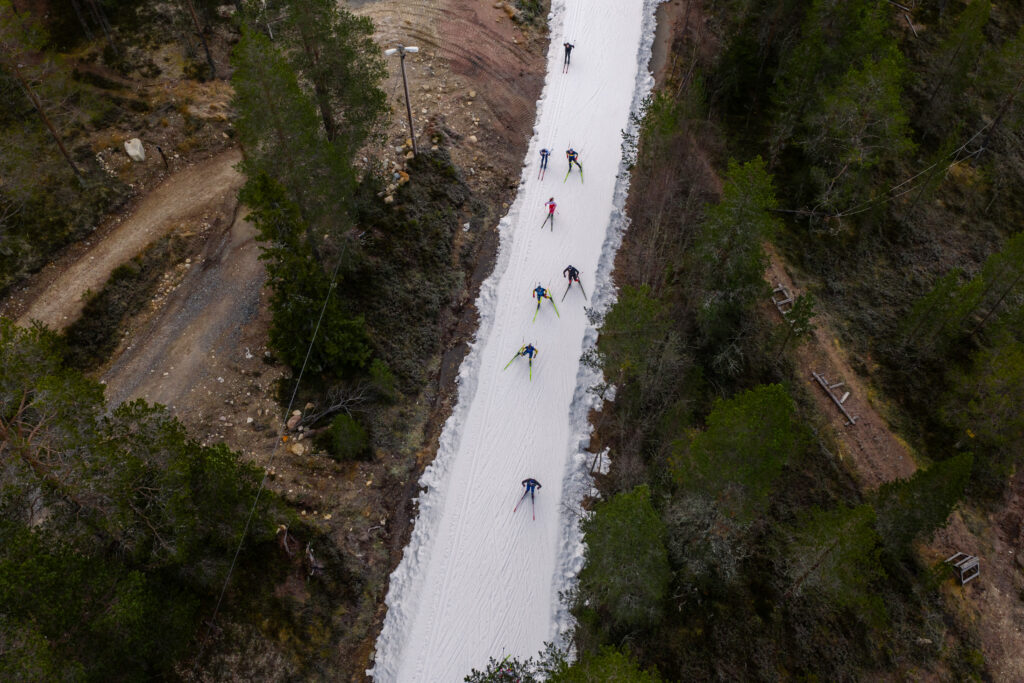
“The problem with almost all early-snow venues is that they’re almost always set up on tough racecourses. On top of that, snow conditions aren’t great — it’s often stored snow with artificial snow on top. That quickly turns into slushy, sugary snow where it’s hard to get a grip. And when many skiers loop around the same short course, it gets even more demanding,” says Bråten Guidon.
That combination is too hard for most skiers, regardless of level or training background.
“Almost no one in Norway is fit enough to ski on difficult racecourses in less-than-ideal conditions, maintaining technical flow and keeping heart rate in zone 1. That’s something only national team skiers and a few from private pro teams can manage, especially during the transition from dryland to snow,” he explains.
As a result, many end up falling into one of the two main traps of early-snow training.
“With such tough conditions, many end up skiing slowly with poor technique because they can’t maintain technical flow while keeping intensity low. That means they get neither the technical nor the physical benefit they want from their time on early snow,” Bråten Guidon says.
Mistake 2: Too hard
Those who fall into the second trap are on the right path — but let their enthusiasm get the better of them.
“Many tend to ski a bit too fast on early snow, just to keep good technique. But the danger is that everything becomes a bit too hard — kind of medium-hard. And if you do that for too long, you risk starting the racing season more tired than fit,” he explains.
Bråten Guidon’s advice to those who recognize themselves in one of these two mistakes is the same:
“When you go skiing, make sure you really ski. That means skiing fast enough to keep good technical flow. If that pushes you into zone 2 or even zone 3, that’s fine — but then shorten the session accordingly. Put away your heart rate monitor and ski at a pace that suits your technique. But maybe ski for an hour instead of an hour and a half.”
He also reminds skiers to maintain easy sessions:
“Easy training is still important. So, if you’re doing harder sessions on snow than planned, include some relaxed roller skiing or running sessions outside the early-snow loops.”
Mistake 3: Too abrupt transition
The last common mistake is switching suddenly from 100% dryland training to 100% skiing as soon as the first snow arrives. That’s rarely a good idea.
“Doing lots of ski sessions overnight if you’re at an early-snow camp for four days is one thing. But if it suddenly snows half a meter at home and you drop all dryland training for skiing, that’s not ideal either. You need some transition and adaptation,” says Bråten Guidon.
“It’s much better to train well on dryland than poorly on snow. So even if you have access to snow, keep doing some hard sessions on dryland. Generally, you can mix roller skiing and skiing until Christmas. And you should maintain one or two short runs per week throughout winter — that will help a lot when the dryland season returns,” he adds.
No need to rush onto the snow in November
Bråten Guidon also reminds skiers that there’s no reason to stress about getting on the snow the moment the first venues open.
“For most people, except elite skiers and juniors aiming for specific selections, there are few important races before Christmas. The Norwegian Cup for juniors doesn’t start until after the New Year, and the same goes for most long-distance races,” says Bråten Guidon.
“Take a deep breath and focus on good training. There are many benefits to systematic, purposeful dryland training compared to standing in line on a short, steep loop with poor snow conditions.”
Updated November 1, 2025: This article is based on one originally published in November 2024 on Langrenn.com.
Are you interested in training for long-distance, traditional cross-country skiing, and biathlon? Click HERE and read more about it on ProXCskiig.com.
Subscribe to our newsletter
Most read
-
-
14.09.2026
-
06.03.2026
-
-
16.09.2026




More Articles
-
Swedish and Norwegian cross-country ski tracks open: Early snow guarantee for 2026
This weekend, several traditional Swedish and Norwegian destinations are launching their early snow offers. Here is an overview of destinations with snow guarantees.22.10.2026