The secret to faster recovery: What and when to eat for effective training
Are you analyzing your training? Do you want to enhance your performance? However, your performance does not improve during the strain when your body is under stress. The key phase for further performance growth is recovery, where you must provide your body with everything it needs.
Your training is undoubtedly crucial as it serves as a stimulus for the body to adapt. This is essentially the foundation of improvement. However, for this process to occur optimally, your body needs to have sufficient nutrients to ensure complete adaptation and recovery within the designated time.
If you shorten the recovery process or fail to provide your body with the necessary nutrients, no performance growth will occur, even if you push yourself to the limit. In fact, there is a risk of the opposite effect, which many athletes can attest to from personal experience: overtraining and chronic fatigue.
This is why recovery, which includes both active and passive rest, stretching, and especially the intake of appropriate fluids and nutrients, is so important. During this phase, the body replenishes depleted energy stores and adapts to the training stimulus it has undergone.
However, it is essential that the body has access to sufficient quality nutrients throughout the entire duration of recovery. This is why nutrition plays a key role.
Recovery as the most important phase of training
Everything is quite simple and physiologically determined. Training leads to a decrease in performance, an increase in fatigue, and exhaustion, placing the body in an undesirable state of catabolism (a breakdown process where more complex substances are converted into simpler ones). Performance growth occurs in the subsequent recovery phase and then in the so-called supercompensation phase (adaptation), where the body strives to adjust and better prepare for the previous negative experience.
Although the training stimulus is necessary, the recovery phase contributes the most to performance growth. Therefore, we should not limit or shorten it in any way, but rather maximize our support for it. The key factor is how quickly we can replenish the muscle glycogen depleted by performance, repair muscle fibers damaged during training, and replenish minerals and fluids.
All of this affects the quality of the following training session and determines whether that training will lead to performance development (in the case of complete recovery) or, conversely, to the risk of overtraining (if another demanding training session is scheduled before the body is optimally prepared).
Benefits of quality recovery
Optimal recovery processes allow athletes to enter their next training session or competition in the best possible condition. This means with replenished energy stores, minerals, fluids, and repaired muscle fibers.
Recovery has its physiological laws, and those who adhere to them will have an advantage over their competitors. This advantage is threefold, as better recovery allows you to:
1) incorporate more training sessions,
2) engage in more frequent intense training sessions, which contribute most to performance growth,
3) enter competitions optimally prepared, with sufficient energy reserves.
How to specifically assist the body in recovery
The most important thing is that recovery begins quickly after performance. This is particularly crucial when an athlete must undergo another intense training session or competition within a few hours of the previous intense session. Simply put, you should address recovery as intensely as the preceding athletic performance.
1st phase of recovery: anabolic window
It occurs in the first 30 minutes after exercise, when our cells are most open to anything that will help them stop catabolism and induce anabolism as quickly as possible (the process by which simpler substances are converted into more complex ones).
This is a state of growth when the body has enough energy to repair damaged tissues, regenerate muscle fibers, and possibly build new ones. And above all, to replenish depleted reserves of muscle glycogen, which is important for endurance athletes.
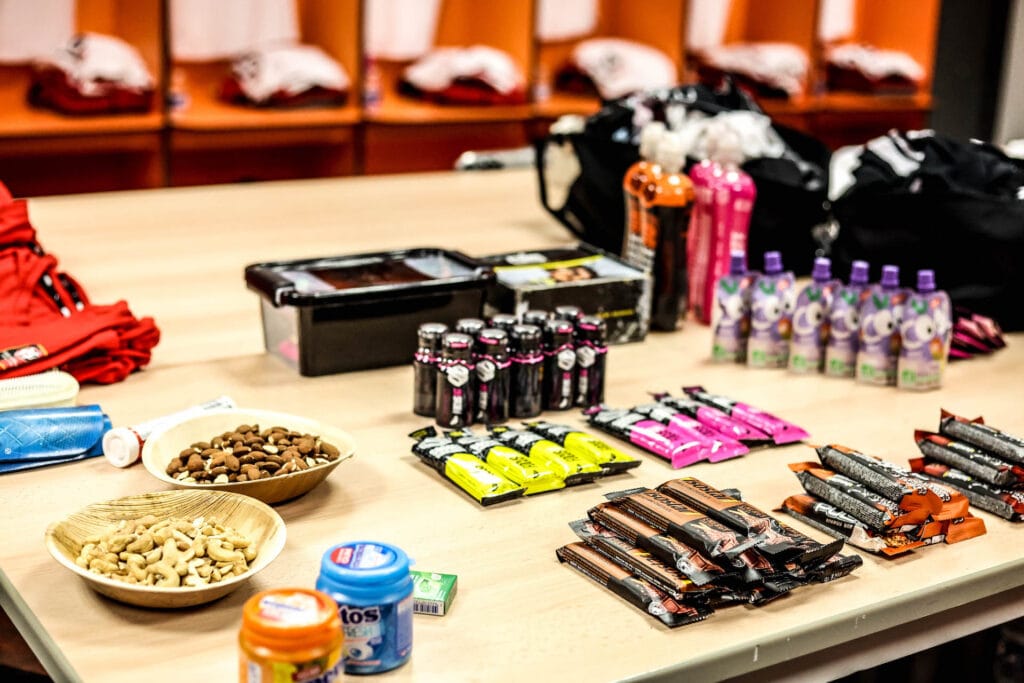
Since the anabolic window only lasts a short time, rapid absorption of essential nutrients is important during this phase. For this reason, it is recommended to take carbohydrates, amino acids, and vitamins in the form of a drink. For this, so-called recovery drinks are used, specially developed to accelerate recovery after sports.
2nd phase of regeneration: internal balance restoration
You should follow up the half-hour anabolic window with a comprehensive nutritional program, especially after a very demanding workout.
In such a case, in the second phase of regeneration (within 6 hours after the exercise), it is necessary to pay particular attention to a sufficient and continuous drinking regimen and also to the intake of wholesome meals:
a) The first meal should consist mainly of carbohydrates and should be eaten within one hour of finishing the exercise. Suitable foods include risotto, pasta with meat, spinach pancakes, rice pudding, spaghetti, etc. If you do not have the option of such a meal, the best solution is to take a second dose of a recovery drink.
b) The next two meals should follow two hours after the previous one, and these meals should have a medium glycemic index and a small amount of protein.
c) Gradually increase your protein intake to repair damaged muscle fibers, improve regeneration processes, and support the immune system. For faster absorption and less strain on the body, it is advisable to supplement protein in the form of so-called protein concentrates.
3rd phase of regeneration: support of the “regeneration” hormone
The “regeneration hormone” in the human body can be called growth hormone. Its task is to regenerate tissues damaged during the day, repair muscle fibers and allow the body to have deep rest (regeneration). Therefore, the activity of growth hormone is essential for the athlete’s body.
Growth hormone secretion occurs automatically and naturally, most notably in the first hours of sleep. However, we can influence its activity by:
a) negatively – by eating fast carbohydrates in the evening (sweets, white bread, improperly prepared rice or pasta, etc.), which will excessively increase blood sugar levels, and therefore insulin, and thus suppress the secretion of growth hormone
b) positively – by consuming proteins, ideally those that provide a long-term release of amino acids. This process will support the activity of growth hormone and therefore regeneration, and at the same time ensure the continuous release of “restorative” nutrients during the night. This is another benefit, as the body will not suffer during the night. Therefore, it is recommended to consume a multi-component protein source in the form of a drink thirty minutes before going to bed.
How to approach regeneration
We said that the intensity of recovery should match the intensity of the load. Now that you know the individual phases of recovery and what happens in the body during them, we can summarize the general recommendations related to training intensity:
After light training: 1st phase only in the form of a drink (an ionic drink will suffice) + definitely support the 3rd phase of regeneration
After a moderate workout: Phase 1 in the form of a recovery drink, or just an ionic drink + BCAA amino acids. In Phase 2, at least the first meal + definitely support Phase 3 of recovery.
After a hard workout or race: intensively address the 1st, 2nd and 3rd phases of regeneration.
Nutritional factors
What are the nutritional factors in each phase that accelerate recovery after intense training or competition?
Phase 1: Replenish fluids and minerals – mineral-containing drinks
Phase 2: Restore glycogen stores – carbohydrates with a high glycemic index + proteins or amino acids (especially glutamine)
Phase 3: Repair damaged tissue and protein synthesis – proteins + BCAA amino acids (especially leucine)
In conclusion
It’s simple. If you want your performance to grow, always think about regeneration. Its pillar is nutrient supplementation, i.e. adequate nutrition. As is clear from the individual regeneration phases, nutrition can significantly support and accelerate them. And as you already know, the faster and better the regeneration, the sooner and better you are prepared for the next training or race. So off to the track!
Are you interested in training for long-distance, traditional cross-country skiing, and biathlon? Click HERE and read more about it.
Subscribe to our newsletter
Most read
-
10.05.2026
-
01.05.2026
-
14.05.2026
-
06.05.2026
-
09.12.2025





More Articles
-
Norwegian star triumphs in new sport
Gave up his Norwegian national team spot last year – on Saturday, he clinched a clear victory in a prestigious road race.02.06.2026