Ernst Alm: Vasaloppet’s First Winner
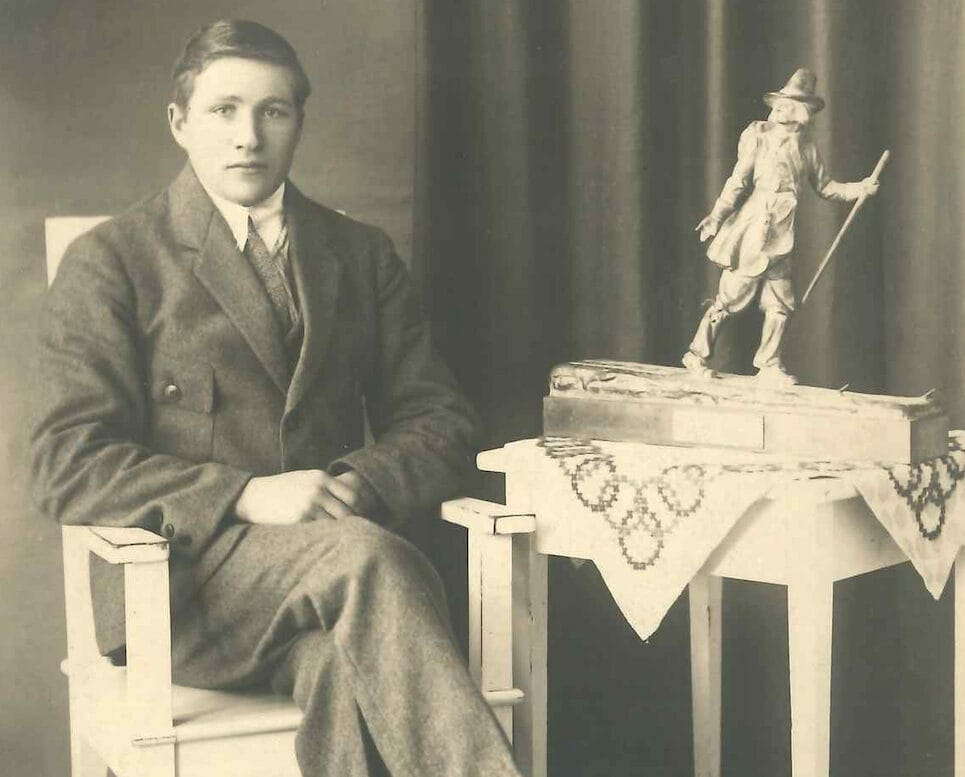
On Sunday, March 5, it’s time for Vasaloppet, to be precise, the 99th edition. Vasaloppet’s first winner in 1922 was Ernst Alm, and here is the story about his tortuous road to victory.
We look back in the almanac, and the fact is that we had to scroll a lot. More specifically, one hundred and one years plus two and a half weeks. In a newspaper article on February 10, 1922, journalist Anders Pers launched Vasaloppet’s idea. This under the heading: “A national ski race.”
A few weeks later, IFK Mora’s board decided to carry out the race, and another two weeks later (March 19), the first Vasaloppet started. A prerequisite for completing the race was that Dagens Nyheter put up SEK 1,000 as a grant for IFK Mora to “be able to organize the competition in style.” During the winter, DN had taken the side of the Swedish skiers in a debate about various sports and thus became Vasaloppet’s first sponsor.
The legendary sports journalist Sven Lindhagen wondered if Vasaloppet could become a major competition. But he later remembered the first Vasaloppet and what made the race a success: “The prizes guaranteed in their abundance and opulence the future of Vasaloppet.” This according to an article by Lars Ingels in the magazine Vasalöparen.
In just twelve days, the organizers received prizes valued at SEK 11,000. In the current monetary value, this corresponds to just over SEK 300,000. It is noteworthy, however, that when it came to Vasaloppet 1922, it was about prizes, for example, silver trophies, and not prize money.
Seven hundred kilometers northeast of the starting point at Olnispagården in Sälen is Västerbotten’s Norsjö. Here lived 22-year-old Ernst Alm, number five in a sibling group of ten. His upbringing was, according to his hometown Hemmingen’s website, as for most boys in the interior of Norrland. This meant early work on the farm; at age 15, it was time to start working in the forest during winter. Ernst was also, for a time, together with some of his brothers, a rider on the Inlandsbanan. It was clear from an early age that there was a skiing talent. In 1921 he
became the Swedish team champion in the 60 kilometers.
According to the Norsjö Skiers’ Museum, he was also out early regarding training methods. Alm is said to have tied a rowing boat to a birch that was “reasonably compliant” and thereby created an equivalent to today’s rowing machines.
As is well known, the invitation to the premiere edition of Vasaloppet came out late. Then his club IFK Norsjö did not consider themselves able to afford to send any skiers to Dalarna.
However, according to Hemmingen.se, the local newspaper Västerbottens-Kuriren offered to pay for travel for a Norsjö skier, and a successful fundraiser later meant that there was a trio of Norsjö skiers in the premiere edition.
Apart from the victorious Alm, it was the second Oskar Lindberg (who won the following year) and John Bergmark, who was 18th. This meant that Norsjö also won the team competition.
But that’s a recent story. Because just getting to Sälen is a story in itself:
“The train to the south departed from Bastuträsk, and grandfather went there with skis. It was a ski trip of several kilometers,” says Mattias Alm, grandson of Ernst Alm.
The Norsjö trio arrived in western Dalarna a couple of days before the start on March 19.
The day before the start, there was a bib number distribution, a mandatory medical examination, and also the pictures from the start were filmed ( See the clip from SVT’s Open Archive here). The reason was that there were no resources to film the regular race, so these pictures were recorded in advance.
The morning after the start, already captured on film, at 6.04 on March 19, 1922, the 119 participants set off in the direction of Mora (139 were registered, and, notably, 117 participants reached the finish line).
And we let the 174-centimeter Ernst Alm take us through his 7 hours, 32 minutes, and 49 seconds on the way to victory. This in a quote from Mora Tidning (taken from the book The Great Adventure by Pelle Marklund):
“This was the longest course I went, and it was really demanding. At the same time, I think it was the nicest competition I participated in. The start went well. The line was no further, and fresh snow was freezing under the skis. I was not among the better Mångsbodarna, where I did not stop to rest. In Evertsberg, I ate, but not as long as the others. In Oxberg, I understood that I was in the lead, and after that check, I skied away from Strål Lars Eriksson and Jonas Persson. Then I still thought I had Hedlund and Lindberg (Per-Erik Särna Hedlund and Oskar Lindberg) before me in the track. I got more and more tired and had no hope of reaching them. Down in Selja, I was told I was first, which gave me new strength. It was fun to be greeted by the people here in Mora, but unfortunately, I happened to push the lady who threw the laurel wreath at me”, said Alm.
The lady who threw on the wreath was Therese Eliasson.
In a later interview with Alm after the victory, he made a somewhat shorter analysis of his victory race and stated to the signature “Mr. Jones” that:
“This was very funny, but it’s not strange. You do the best you can, and someone has to win.”
Last Summer, the memory of Ernst Alm’s Vasaloppet victory was celebrated. This in connection with a ceremony in Hemmingen, where, among other things, former Vasaloppet general Rolf Hammar participated. And so does the grandson Jakob Alm:
“We did not meet grandfather and grandmother so much. They lived in Skelleftehamn but visited us a couple of times. But grandfather was taciturn and told very little about his skiing,” says Jakob Alm.
“Grandpa also participated in the Olympics in Chamonix in 1924 and finished sixth on the 50km there, but it was something that it took quite a long time before I found out. But I do not know if it was a sign of the familiarity that existed at that time. Part of the culture of not being remarkable,” says Mattias Alm.
Ernst Alm passed away in 1980 at the age of 80. Apart from his historic victory in Vasaloppet, he had also become the first Swedish champion in 20 kilometers (that distance was run only three times, after a break of five years, it was restarted, but then as 15 kilometers). Alm also won the individual 60km in 1924 (changed to 50km in 1927).
But last winter, the two Alm brothers were in the starting field when the Jubilee Vasa was contested. This as a centennial tribute to the premiere in 1922:
“We had already talked a few years ago that it would be fun to go when the Vasaloppet turns 100 years old, and I would say that everyone who went there for the first time deserves praise. Because if you have skied Vasaloppet once, you know what a challenge and the cool thing it is. Then you can say this was a nice way to pay tribute to grandfather and somehow create contact with him. And to ski with similar equipment as they did in 1922 was really a way to get a feel for how tough those premiere skiers were,” says Jakob Alm.
Thirteen hours and fifty-three minutes after the start, the Alm brothers stumbled into the finish where another Alm a hundred years earlier “had a laurel wreath thrown at him.”
“It was very tough to hustle around on two-and-a-half-meter-long skis for fourteen hours. At the same time, it was a very fun thing to do together as brothers, and it was nice to have each other and be able to support, and it was fantastic support along the course. Then it was tough, but I thought of giving up? Never,” says Mattias Alm.
The article was first published on ProXCskiing.com on July 18, 2022.
Subscribe to our newsletter
Most read
-
11.05.2026
-
23.08.2022
-
03.08.2026
-
05.08.2026
-
19.09.2026



More Articles
-
Biathlon Summer Tour opener in France also crowns French sprint champions
This past weekend, September 19 and 20, in La Féclaz, France, the first stage of the Biathlon Summer Tour took place, with some of the races serving as part of the French Sprint Championships.21.09.2026