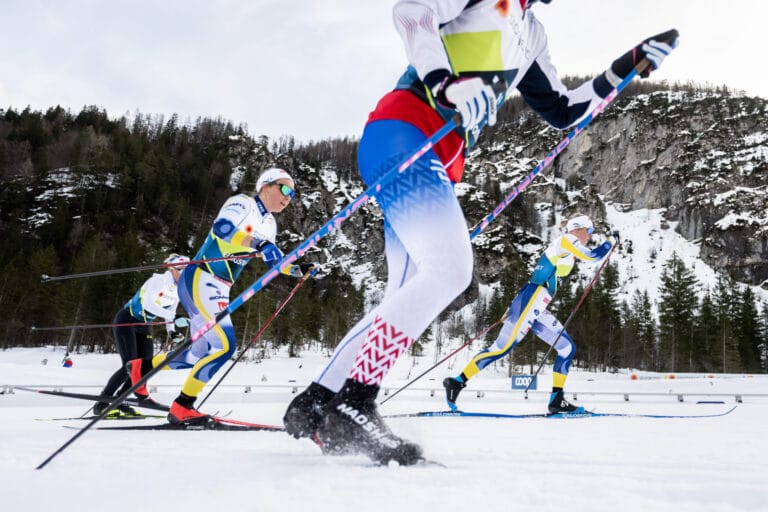
Get stronger for winter: Why strength training matters in long-distance skiing

Whether you’re an elite skier or a passionate recreational athlete, the off-season is the perfect time to build the strength foundation that will power your performance next winter.
Strength training is often overlooked in endurance sports, but for long-distance skiing, especially double poling, it can make a significant difference in speed, technique, and injury prevention.
As summer is just around the corner and long-distance skiers have already started their preparations for the next winter season, it’s essential to consider the importance of strength training. Specifically for double poling, developing upper body strength and endurance is crucial. Read our article to get some tips about how to incorporate it into your training plan.
The season is over, and summer training is just around the corner. Your body may benefit from some time to recover from the Winter season, but you are probably already thinking about improving your best results next season. Strength training is essential.
Training for cross-country and long-distance skiing is demanding. You need to put all the puzzle pieces together to create a comprehensive training plan that incorporates endurance, interval training, speed, strength, and recovery. And then, you also need to think about nutrition and mental preparation for the most demanding races.
One of the most critical components of the puzzle is strength training, an essential aspect of long-distance skiing, as it can enhance overall performance and reduce the risk of injury.
Long-distance skiing requires a high level of endurance, muscular strength, and the ability to perform explosive movements for hills and sprints. Therefore, strength training can enhance the athlete’s overall muscular strength, power, and endurance, improving skiing efficiency and technique.
Why should you implement strength training?
There are some key reasons why it is essential for long-distance skiing. It is an endurance sport requiring a great deal of muscular endurance. Strength training can help improve the athlete’s ability to sustain high muscular activity for extended periods. By increasing muscular endurance, the athlete can maintain proper form and technique throughout the race, improving performance.
Long-distance skiing also requires explosive power, especially during uphill sections and sprints. Strength training can help improve power output, which in turn can increase an athlete’s speed and ability to handle more challenging terrain.
Another reason strength is essential is that long-distance skiing can put a lot of stress on the body, especially the lower body. Strength training can help improve an athlete’s muscular strength, which in turn supports the joints and reduces the risk of injury.
Ultimately, strength training can enhance overall body mechanics and technique. For example, exercises targeting the core and upper body can help improve balance and stability, which in turn enhances skiing technique, particularly double poling.
The importance of upper body strength for double poling
Double poling is a technique used in long-distance skiing, where the athlete uses their upper body muscles to propel themselves forward while skiing on a flat or slightly uphill terrain. This technique requires a significant amount of upper body strength and endurance, making strength training essential.
Double poling requires significant upper body power, which can be improved through strength training. Exercises such as pull-ups can help increase upper body strength and power output, allowing athletes to generate more force with each poling motion.
Double poling is an endurance-based technique that requires a high level of muscular endurance in the upper body muscles. Strength training can help improve an athlete’s ability to sustain a high level of muscular activity for more extended periods, which can translate into improved performance on the ski track.
Strength training can also help improve an athlete’s muscular strength, which in turn supports the joints and reduces the risk of injury. Strengthening the muscles around the shoulders and upper back can help prevent common injuries, such as shoulder strains and rotator cuff injuries.
The best tips for strength training during the Spring and Summer
Specific strength sessions and skiing or roller skiing can develop double poling strength. Now that winter is over, most long-distance skiers use roller skis for training.
Roller skiing is a popular off-season training activity for cross-country skiers, and it can be a highly effective way to develop strength. The continuous motion of roller skiing requires the use of the legs, core, and upper body muscles, which can improve overall strength and endurance. Moreover, the power developed through roller skiing can transfer directly to improved performance on the ski track.

Roller skiing is a low-impact activity that places less stress on the joints than other forms of strength training, such as weightlifting or running. This makes it an excellent option for athletes who want to develop strength without putting excessive strain on their joints. However, for recreational skiers, it might be better to start easily.
“Go easy in the beginning; roller skiing is more stressful on the joints than skiing on snow,” says Martin Sundqvist, founder of SkigripSweden.
“Do many different types of sessions, like long and slow on flat courses, long and short intervals uphill, sprints, and so on.”
Then, Martin Sundqvist advises continuing to develop strength through some specific exercises.
“Continue to build your strength with pull-ups and hanging leg raises.”
Pull-ups are a sport-specific exercise that mimics the movement patterns used during double poling. By incorporating pull-ups into your training program, you will improve muscle memory and develop neuromuscular adaptations that transfer directly to improved technique and performance on the ski track. Martin advises focusing on low repetitions with heavy weights.
Finally, Skigrip’s founder believes that there is another solution for more seasoned skiers or those who want to take their strength to the next level.
“Focus on eccentric overload on key exercises. Use flywheel or other means.”
Eccentric training is a type of strength training that involves contracting the muscle while it lengthens, as opposed to concentric training, which involves contracting the muscle while it shortens. Eccentric training can be particularly beneficial for long-distance skiers who focus on double poling because it allows them to build greater strength.
In summary, strength training is essential for enhancing power output and muscular endurance, reducing the risk of injury, and refining the overall technique for double poling. By incorporating strength training into the training program, long-distance skiers can improve their performance and achieve their goals on the ski track.
*This article was originally published on 24.05.2025 and updated today.
Are you interested in training for long-distance and traditional cross-country skiing? Click HERE and read more about it.
Subscribe to our newsletter
Most read
-
-
14.09.2026
-
06.03.2026
-
16.09.2026
-
02.09.2026





More Articles
-
How to train properly: Understand training intensities
Some athletes have a coach who writes their training plans and guides their preparation. Others rely on their smartwatch, while some acquire knowledge through trial and error, often taking years to figure out how to train effectively. To manage your training, it's crucial to differentiate between the various training intensities.10.10.2026