Olympics 2026: Complete guide to the men’s 20km skiathlon

There is only one big favorite for the men’s first cross-country race at the Olympics. Johannes Høsflot Klæbo won all 6 gold medals at last year’s World Championships in Trondheim, Norway.
The question is whether he can also do it at the Winter Olympic Games in Val di Fiemme. He was totally in a class of his own in the last World Cup round in Goms, Switzerland, and the question is whether anybody has a chance to beat him.
Sunday, February 8: 20km Skiathlon C/F Men (More information can be found HERE)
- 12:30 CET: 20km Skiathlon C/F, Men
The start list can be found HERE
ABOUT TODAY’S EVENT
Skiathlons have been held in several formats throughout World Championship history. In the beginning, it was contested over two days, with an individual race on the first day and a pursuit start the following day. Since 2003, skiathlon has been raced over 15 km with a ski change.
Today, the distance is 20km, as women and men now compete over the same distances.
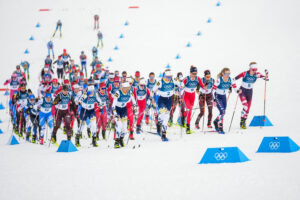
It is a mass start. The race begins with a 10km in classic technique. The skiers then enter their individual boxes, where skate skis and poles are laid out and ready. After the ski change, they complete 10km in skating technique.
The first skier to cross the finish line wins. Often, a freestyle specialist prevails, since the final section is skated. However, we also sometimes see the strongest classic skiers break away and build a lead that holds all the way to the finish.
It is also essential to be quick during the ski change. If problems occur with bindings, skis sliding away, or similar issues, valuable seconds can be lost, and a skier may lose contact with the group they entered the exchange zone with.
Olympic Champions — Men’s Pursuit / Skiathlon (Cross-Country Skiing)
Pursuit (10km + 15km / 10km + 10km combined)
(Early combined pursuit format at Olympics)
- 1992 – Bjørn Dæhlie (NOR) – 10km + 15km combined pursuit (Albertville)
- 1994 – Bjørn Dæhlie (NOR) – 10km + 15km combined pursuit (Lillehammer)
- 1998 – Thomas Alsgaard (NOR) – 10km + 15km combined pursuit (Nagano)
- 2002 – Thomas Alsgaard & Frode Estil (NOR)* – 10km + 10km combined pursuit (Salt Lake City)
*Gold was shared by Thomas Alsgaard and Frode Estil (co-champions) in 2002.
Skiathlon / Pursuit (15km + 15km / 30km format)
(Modern skiathlon format combining classic and freestyle)
- 2006 – Yevgeny Dementyev (RUS) – 30km pursuit (Torino)
- 2010 – Marcus Hellner (SWE) – Skiathlon (Vancouver)
- 2014 – Dario Cologna (SUI) – Skiathlon (Sochi)
- 2018 – Simen Hegstad Krüger (NOR) – Skiathlon (Pyeongchang)
- 2022 – Aleksandr Bolshunov (ROC) – Skiathlon (Beijing)
Note: The skiathlon event has replaced older pursuit formats since the mid-2000s. In the modern race, skiers complete the first half in classic technique, change skis, then finish in freestyle (skate) technique.
WORLD CHAMPIONS (different distances)
30KM
- 1926 Matti Raivio, Finland
- 1954 Vladimir Kuzin, Soviet Union
- 1958 Kalevi Hämäläinen, Finland
- 1962 Eero Mäntyranta, Finland
- 1966 Eero Mäntyranta, Finland
- 1970 Vjatjeslav Vedenin, Sovjet
- 1974 Thomas Wassberg, Sweden
- 1978 Sergej Saveljev, Soviet Union
- 1982 Thomas Eriksson, Sweden
- 1985 Gunde Svan, Sweden
- 1987 Thomas Wassberg, Sweden
- 1989 Vladimir Smirnov, Soviet Union
- 1991 Gunde Svan, Sweden
- 1993 Bjørn Dæhlie, Norway
- 1997 Alexei Prokurorov, Russia
- 1999 Mika Myllylä, Finland
- 2001 Andrus Veerpalu, Estonia
- 2003 Thomas Alsgaard, Norway
30KM SKIATHLON (15km classic + 15km free)
- 2003 Per Elofsson, Sverige (10+10km)
- 2005 Vincent Vittoz, France
- 2007 Axel Teichmann, Germany
- 2009 Petter Northug jr, Norway
- 2011 Petter Northug jr, Norway
- 2013 Dario Cologna, Switzerland
- 2015 Maxim Vylegzhanin, Russia
- 2017 Sergei Ustiugov, Russia
- 2019 Sjur Røthe, Norway
- 2021 Alexander Bolshunov, Russia
- 2023 Simen Hegstad Krüger, Norway
- 2025 Johannes Høsflot Klæbo, Norway (10+10km)
PURSUIT START (10km classic and 15km free, 15km with pursuit start)
- 1993 Bjørn Dæhlie, Norway
- 1995 Vladimir Smirnov, Kazakhstan
- 1997 Bjørn Dæhlie, Norway
- 1999 Thomas Alsgaard, Norway
- 2001 Per Elofson, Sverige (10+10 km)
FAVORITES
Johannes Høsflot Klæbo, Norway
It is enough with one favorite here. The six-time World Champion from last season can win all kinds of scenarios. Klæbo knows he has the best sprint.
Nobody is better than him at skating, and he is in better shape than he has been at any time in his career. The only possibility of failure is if he suddenly cracks in the classic part. But he was in a class of his own in the last World Cup race before the Olympics, so why should he do that? Of course, accidents or bad skis can happen, but that never seems to occur with Klæbo.
Harald Østberg Amundsen, Norway
Some of the same qualities as Klæbo, but just a little weaker in all moments. Amundsen has the sprint and is one of the best in skating. His weakest part is classic skiing, but he was on the podium in Goms just before the Games.
Martin Løwstrøm Nyenget, Norway
Has prepared a little differently than the other Norwegians on this side of the New Year. Impressive win in Oberhof. But Nyenget may be better in classic. And he doesn’t have the sprint of Klæbo or Amundsen. But he is a strong man and wants a quick start. This man can split the field early. Hopefully, for him, he has better luck than in the World’s last year when he crashed from a possible medal.
OUTSIDERS
Mattis Stenshagen, Norway
He has gone a long way to qualify for the Olympics. Stenshagen has shown impressive results when he finally got the chance to shine. But did it cost him too much? Will he be able to find the same form in Val di Fiemme as at the beginning of the season? He is strong in both techniques, but he will not beat Klæbo in the sprint.
Elia Barp, Italy
The young Italian has made progress this Winter. He might be extra motivated with the Games on home snow. A medal will be a surprise, but he is a racer who can follow the leaders for a long time. The question is how long.
Federico Pellegrino, Italy
In his last Olympics, the Italian finally got to do it at home, even though he comes from the Aosta Valley. Don’t look upon Pellegrino as a pure sprinter. He is a master at hanging on with the best, even if he is tired. If he can manage the first half of the skiathlon, he has a chance for a medal here.
Mika Vermeulen, Austria
The Austrian living in Norway has shown that he is one of the few who can race with the Norwegians’ “red army.” But Vermeulen had a significant setback when he got sick over Christmas and New Year, and he has struggled to return to the exact shape since.
Gus Schumacher, USA
Sitting in the top 10 on the World Cup coming into the Olympics. Showed form in the last World Cup in Goms, and Schumacher and all the Americans are always a little extra motivated for the Olympics. It means a lot to them because Americans count the Olympics much higher than the World Championships and World Cups. Schumacher has a good sprint at the end.
Savelii Korostelev, AIN
The Russian talent makes a controversial start here. He is clearly a very talented skier, as he has shown in the few World Cup races he has raced this Winter. But given the current situation and his stripped nationality, the question is whether he gets the support he needs to fight for the medals. His mother, Natalia Korosteleva, was a top skier in the Russian national team back in the day.
You will find the start list HERE
Cross-country skiing schedule – Olympics 2026
Saturday, February 7: 20km Skiathlon C/F Women (More information can be found HERE)
- 13:00 CET: 20km Skiathlon C/F, Women
Sunday, February 8: 20km Skiathlon C/F Men (More information can be found HERE)
- 12:30 CET: 20km Skiathlon C/F, Men
Tuesday, February 10: Sprint C Women and Men (More information can be found HERE)
- 9:15 CET: Sprint Quali C, Women
- 9:15 CET: Sprint Quali C, Men
- 11:45 CET: Sprint Final C, Women
- 11:45 CET: Sprint Final C, Men
Thursday, February 12: 10km Interval Start F Women (More information can be found HERE)
- 13:00 CET: 10km Interval F, Women
Friday, February 13: 10km Interval Start F Men (More information can be found HERE)
- 11:45 CET: 10km Interval F, Men
Saturday, February 14: 4×7.5km Relay C/F Women (More information can be found HERE)
- 12:00 CET: 4×7.5km Relay C/F, Women
Sunday, February 15: 4×7.5km Relay C/F Men (More information can be found HERE)
- 12:00 CET: 4×7.5km Relay C/F, Men
Wednesday, February 18: Team Sprint Women and Men (More information can be found HERE)
- 9:45 CET: Team Sprint F Quali, Women
- 9:45 CET: Team Sprint F Quali, Men
- 11:45 CET: Team Sprint F, Women
- 11:45 CET: Team Sprint F, Men
Saturday, February 21: 50km Mass Start C Men (More information can be found HERE)
- 11:00 CET: 50km Mass Start C, Men
Sunday, February 22: 50km Mass Start C Women (More information can be found HERE)
- 10:00 CET: 50km Mass Start C, Women
Complete program for the Winter Olympic Games can be found HERE
Val di Fiemme, a classic Nordic skiing venue, promises thrilling racing on courses steeped in Olympic history. Fans around the World will have the chance to cheer on athletes across all distances, from explosive sprints to grueling marathons.
Are you interested in traditional cross-country skiing? Click HERE and read more about it.
As a member of ProXCskiing.com, you get full access to all content on the site. Also, live streaming of Ski Classics events with English commentaries is available.
When you become part of one of the World’s leading XC ski communities, you will receive many exclusive offers all year round.

Subscribe to our newsletter
Most read
-
21.02.2026
-
03.12.2021
-
22.02.2026
-
30.08.2026
-
18.02.2026


More Articles
-
Hanna Fine: “It would be cool to make it into the top 15 in the overall standings”
The Pro Team athlete is one of the few French women who have been competing on the Ski Classics World Championship circuit for several years now. Since her debut on the circuit at the 2024 Engadin La Diagonela, Hanna Fine has continued to improve.20.09.2026