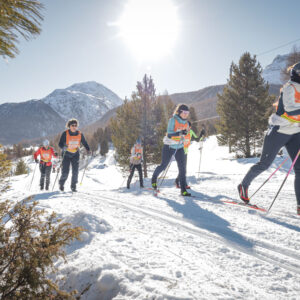
Life between the shooting range and the mixed zone: The cameraman you recognize by his legs

Do you enjoy watching biathlon? Behind the TV broadcasts we follow from the comfort of our homes are people working directly on site. One of them is cameraman Jan Medlík, and at the same time, the only one who films in shorts in all kinds of weather.
Jan Medlík works for a Brno-based television station in the Czech Republic and films a wide range of sports, from football, ice hockey, and volleyball to orienteering and biathlon, which has grown closest to his heart. He has been traveling to World Cup events for more than ten years.
“The first two years, we traveled on our own with reporter Tomáš Lachman, only on weekends and to selected events, and already then, I realized how demanding an athlete’s life is. From the 2017/18 season, Czech Television began offering full coverage of all races, and we started traveling to the entire World Cup,” he says.
Incredible development
In recent years, the technology needed for film broadcasts has made tremendous progress. Jan also recalls the challenging beginnings:
“In the first season, there was no other connection than via satellite, which is technically and financially very demanding. We traveled only with a camera and a laptop, and after every interview, we ran from the shooting range to the press center and sent the interview from there. That meant maybe 10–15 times per race, so we certainly warmed up.”
Today, they can rely on transmission backpacks and streaming devices that can create a live broadcast using data from SIM cards installed in the unit.
“We are now able to deliver interviews from the shooting range to viewers much faster. We can even offer live coverage of the shooting of Czech athletes and involve viewers more in the action. Broadcasts that once cost hundreds of thousands have been replaced by a device the size of a shoebox, costing only the data plan for six SIM cards inside,” explains the Brno cameraman.
What’s behind the camera?
Of course, he stands behind the camera, but what does Jan Medlík specifically film for Czech viewers?
“The day before the first races begin, we film pre-race training sessions and try to bring interesting stories from the venue and from the Czech team, what the mood is like, and how the athletes feel.”
One camera operator cannot be everywhere at once. The goal is to cover two locations, the shooting range and the mixed zone, from where he and the reporter convey immediate impressions from Czech athletes or international stars.
The Biathlon World Cup takes place at the same venues each year, so Czech Television staff also try to find unusual local connections.
“In Östersund, due to a lack of topics, we visited a moose farm, because moose are typical animals of that region. The owner was a big biathlon fan and gave the moose names after biathlon stars who came to visit,” Medlík recalls.
In shorts
However, the Czech cameraman is a genuine curiosity on the World Cup circuit, thanks to the shorts he wears in all weather conditions.
“My shorts are probably a generally known thing by now. At first, they attracted a lot of attention; I even did interviews for foreign TV stations because of them. Everyone notices and remembers it easily. Some well-known people can access restricted areas without accreditation thanks to their face; I can do it thanks to my legs.”
Kneeling or walking for hours in the snow while carrying a heavy camera would not be manageable for just anyone, even in shorts.
“I like perceiving winter. I like feeling the cold on my body. But of course, I have good boots, socks, and a jacket, so you try to keep the more vulnerable parts of the body warm.”
He admits, however, that it is not always easy to withstand the temperatures and harsh conditions.
“The perception of temperature is subjective, and the perceived temperature can differ from what the thermometer shows. In Canmore, Canada, some races were once canceled due to -30°C frost, but there was no wind, the sun was shining, and the perceived temperature was perfectly fine for shorts. Unlike Östersund in Sweden, where it is windy and often very cold because of the lakes. Just a few degrees below zero, and the cold creeps in much more.”
The story continues below.

The most extreme weather he experienced was at the Olympic Games in Beijing.
“Everyone warned us that it can be extremely cold in China. That was the first time I hesitated about not wearing regular trousers. I even had them packed with me, which I normally don’t. It was around -18°C, and the wind was blowing snow across the shooting range, where there was nowhere to hide. In the end, it was extreme only on the first day, at least for me, but temperatures were still close to -20°C.”
Jan Medlík also recalls an unpleasant situation when a colleague from German television collapsed nearby.
“Fortunately, nothing serious happened, and the guy was fine soon, but standing there in shorts, I felt rather out of place at that moment.”
Today, biathlon, like other winter sports, struggles with a lack of snow and unfavorable weather.
“Often, temperatures are above zero, and I can laugh that I’m prepared for it, while it must be extremely hot for the athletes,” he adds.
Memories from filming
When asked whether he has any memorable anecdotes from biathlon races, he answered almost immediately:
“A biathlon broadcast from the shooting range and the course is covered by dozens of cameras. Once in Ruhpolding, there was a power outage across the entire venue right during the race. They had backup generators, but it took time to get them running. Broadcast trucks and cameras stopped working. The only footage that could be transmitted was mine, thanks to the transmission backpack with its own battery. So, my image was fed into the Prague studio, but nothing else. With that single camera, I had to look for interesting athletes arriving and make sure it was clear where they were shooting. I really didn’t envy the commentator in the Prague studio at that moment.”
Part of biathlon
Ten years of full-on work, moving from one World Cup to the next, have made Jan Medlík part of the biathlon family, just like coaches, athletes, organizers, and others.
“I used to follow biathlon before, but my perception of the sport has shifted a lot over the years. How relatively small details can affect athletes. And I hope that thanks to our work, we’ve managed to pass these insights on to the viewers as well,” he concludes.
Original article from Bezky.net.
Are you interested in biathlon? Click HERE and read more about it.
Subscribe to our newsletter
Most read
-
07.10.2026
-
27.09.2026
-
06.10.2026
-
30.09.2025
-
13.01.2026

More Articles
-
Member offer: 15% off trail passes at Torsby Ski Tunnel
While many are still waiting for the snow to fall, you can already click into your skis. At Torsby Ski Tunnel in Sweden it's winter all year round, and right now ProXCskiing members get 15% off trail passes.21.10.2026