France’s biathletes: built for medals — and to handle the pressure
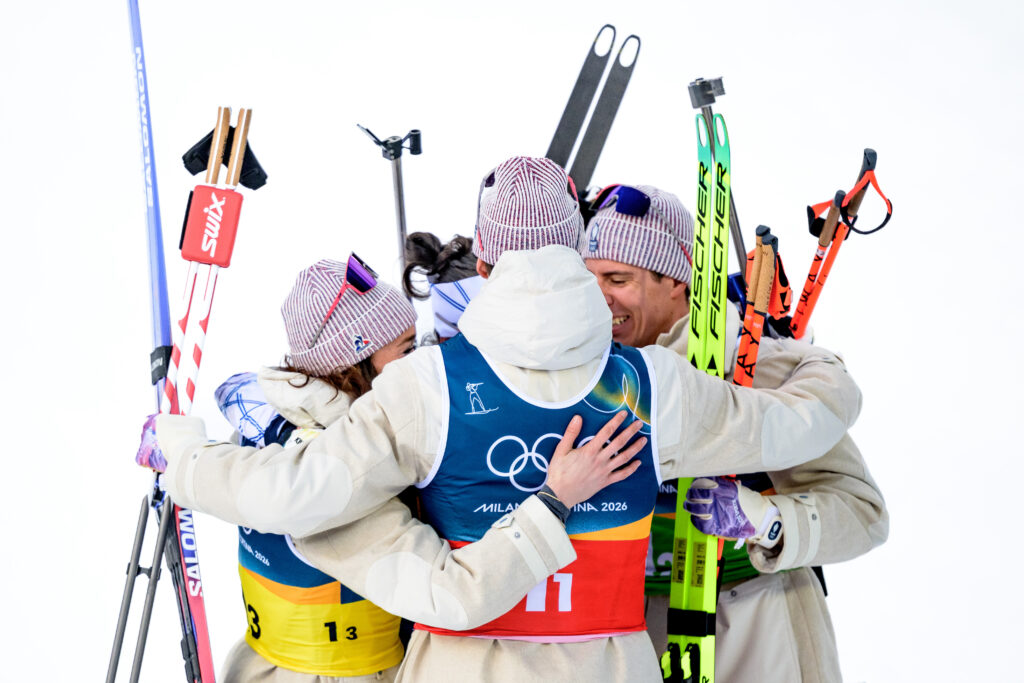
France does not enter an Olympic biathlon season hoping things will fall into place. It arrives with a system, depth on both sides, and athletes who have grown up learning to perform under pressure.
That reality has already defined much of the 2025/26 World Cup winter. Lou Jeanmonnot leads the women’s overall standings. Éric Perrot sits on top of the men’s race. And when medals were on the line early at the Olympic level, France delivered immediately, winning mixed relay gold at the Olympic venue in Antholz/Anterselva with a performance that felt very familiar: strong ski speed, controlled shooting, and an anchor leg that refused to flinch.
None of it feels accidental. And none of it feels new.
So, what does “success” realistically look like for France at the Olympics — and why does this team keep finding itself in medal conversations when pressure tightens?
Also Read: France claims Mixed Relay gold at Milano-Cortina 2026
The Olympics 2026 French Team: Depth That Creates Options
The official French Biathlon team selection for the Olympic season is loaded — not only with stars, but with flexibility.
Women
- Justine Braisaz-Bouchet
- Lou Jeanmonnot
- Océane Michelon
- Jeanne Richard
- Julia Simon
- Camille Bened
Men
- Émilien Claude
- Fabien Claude
- Quentin Fillon Maillet
- Émilien Jacquelin
- Éric Perrot
- Oscar Lombardot
This group matters not just for results, but also for how these athletes race when things get uncomfortable — a crucial trait in Olympic biathlon.
Also Read: French biathlon team confirmed for the 2026 Winter Olympics
Key Names — and What They Suggest Under Olympic Pressure
Lou Jeanmonnot: A New Center of Gravity
Leading the overall World Cup during the Olympic season draws attention as much as it builds confidence. Jeanmonnot has handled both calmly.
She is not built around all-or-nothing brilliance. Instead, her strength lies in stacking high-level finishes and staying in contention until the race opens a door. In Olympic conditions — where wind shifts can turn favorites into chasers in minutes — that profile often ages well.
Jeanmonnot does not need to dominate ski splits to win medals. She needs an opportunity. And this season, she keeps putting herself exactly there.
Read More: “I am stubborn and passionate”
Éric Perrot: Order in a Chaotic Men’s Field
Perrot leading the men’s overall this deep into winter is a signal that he has learned to manage volatility — something few athletes do consistently.
His discipline, especially on the range, makes him particularly interesting in the individual format, where time penalties punish impatience. At altitude, that control becomes even more valuable.
Olympic biathlon rarely rewards panic. Perrot rarely races like he’s panicking.
Read More: Gets the best advice at home – in two countries
Quentin Fillon Maillet: Experience You Can Lean On
Few athletes in the field understand Olympic chaos better. At Beijing 2022, Fillon Maillet won five medals and turned unpredictability into momentum.
Even if he is not the fastest Frenchman on skis every day, his value remains enormous. He stabilizes relays. He absorbs pressure. And when races unravel, he often stays upright long enough to capitalize.
France has learned that championship teams are not built only on peak form — they are built on reliability when things get strange.
Julia Simon: A Closer Who Looks Comfortable There
France’s mixed relay gold leaned heavily on Simon’s final leg, and it was no coincidence.
Simon has developed into the type of anchor leg every team wants: aggressive, composed, and visibly energized when everything is on the line. She does not just tolerate pressure — she seems to enjoy it.
If France collects relay medals at these Games, Simon’s ability to deliver late will be a major reason.
The Claudes and Jacquelin: Tactical Weapons
Fabien Claude, Émilien Claude, and Émilien Jacquelin give France something many teams lack: interchangeable momentum.
They can be rotated depending on conditions, formats, and form without weakening the lineup. France does not need one dominant men’s superstar to dictate outcomes — it can attack races in waves.
At the Olympics, that flexibility is a weapon.
Why France Keeps Doing This on the Olympic Stage
The Fourcade Era: Learning How to Win
PyeongChang 2018 reshaped French biathlon. Martin Fourcade’s three gold medals — including mixed relay gold — were not just individual achievements. They established a culture: process-driven preparation, emotional control, and relays treated as collective missions rather than secondary events.
That mentality never left. Even now, French teams often look organized when others look reactive.
Before Fourcade: Proof of Continuity
French Olympic success did not begin in 2018. Vincent Defrasne’s pursuit gold in Turin 2006, combined with relay medals across his career, showed that France had already built a system capable of producing championship athletes.
That continuity matters. It suggests structure, not coincidence.
Beijing 2022: Resetting Expectations
Fillon Maillet’s five-medal explosion in Beijing did more than elevate his own legacy. It reset France’s internal expectations of what is possible across a single Olympic fortnight.
Since then, France has raced like a team that expects to contend — not one that hopes to.
What “Success” Looks Like for France Now
Olympic biathlon remains brutally unpredictable. Wind erases preparation. One mistake can end everything. So, success is not about dominance — it is about probability.
Relays as the Foundation
France’s depth makes relays its most reliable medal path. Mixed relay gold has already validated that approach.
If France leaves these Games with multiple biathlon medals, relays are likely to account for a significant share of them.
Also Read: France claims Mixed Relay gold at Milano-Cortina 2026
Individual Medals — Possibly from Unexpected Places
Jeanmonnot and Perrot carry favorite status, but Olympic champions often emerge from just below the spotlight — the athlete who shoots 19/20 while others struggle.
France’s advantage is that many of its athletes already have the necessary ski speed. On the right day, patience alone can turn that speed into gold.
Options, Not Dependence
Some nations live and die by one name. France does not.
Different lineups. Different formats. Different heroes. Internal competition stays high, and form tends to peak when championships arrive rather than fading.
That is rarely an accident.
The Bottom Line
France’s biathlon team does not feel like a gamble. It feels like a machine with multiple ways to win:
- World Cup leaders on both the women’s and men’s sides
- Proven Olympic performers who understand pressure
- A closer who thrives when everything is burning
- Depth that absorbs bad luck instead of collapsing under it
France should leave this Olympic biathlon with multiple medals. The only real uncertainty is how high that number climbs — and whether this team edges from “expected success” into something approaching historic.
Biathlon schedule – Milano-Cortina 2026
Sunday, February 8: Mixed Relay (M+W) (More information can be found HERE)
- 14:05 CET: Mixed Relay, Men + Women
Tuesday, February 10: Men 20km Individual (More information can be found HERE)
- 13:30 CET: 20km Individual, Men
Wednesday, February 11: Women 15km Individual (More information can be found HERE)
- 14:15 CET: 15km Individual, Women
Friday, February 13: Men 10km Sprint (More information can be found HERE)
- 14:00 CET: 10km Sprint, Men
Saturday, February 14: Women 7.5km Sprint (More information can be found HERE)
- 14:45 CET: 7.5km Sprint, Women
Sunday, February 15: Men 12.5km Pursuit and Women 10km Pursuit (More information can be found HERE)
- 11:15 CET: 12.5km Pursuit, Men
- 14:45 CET: 10km Pursuit, Women
Tuesday, February 17: Men 4×7.5km Relay (More information can be found HERE)
- 14:30 CET: 4×7.5km Relay, Men
Wednesday, February 18: Women 4x6km Relay (More information can be found HERE)
- 14:45 CET: 4x6km Relay, Women
Friday, February 20: Men 15km Mass Start (More information can be found HERE)
- 14:15 CET: 15km Mass Start, Men
Saturday, February 21: Women 12.5km Mass Start (More information can be found HERE)
- 14:15 CET: 12.5km Mass Start, Women
Complete program for the Winter Olympic Games can be found HERE
Antholz-Anterselva promises breathtaking courses for athletes and spectacular viewing for fans. With every shot and ski stride counting, the biathletes will aim for the podium in every race, making the biathlon one of the most eagerly watched events of the 2026 Winter Games.
Are you interested in biathlon? Click HERE and read more about it.
As a member of ProXCskiing.com, you get full access to all content on the site. Also, live streaming of Ski Classics events with English commentaries is available.
When you become part of one of the World’s leading XC ski communities, you will receive many exclusive offers all year round.

Subscribe to our newsletter
Most read
-
16.02.2026
-
19.02.2026
-
11.02.2026
-
08.02.2026
-
15.06.2026


More Articles
-
Hedegart: “It will be greater than Olympic golds”
Just three months after returning to biathlon, Einar Hedegart has set a goal he believes will surpass the two Olympic golds he won last winter.27.07.2026