CYCLING TRAINING: VO2max intervals – expanding the ceiling of your endurance engine
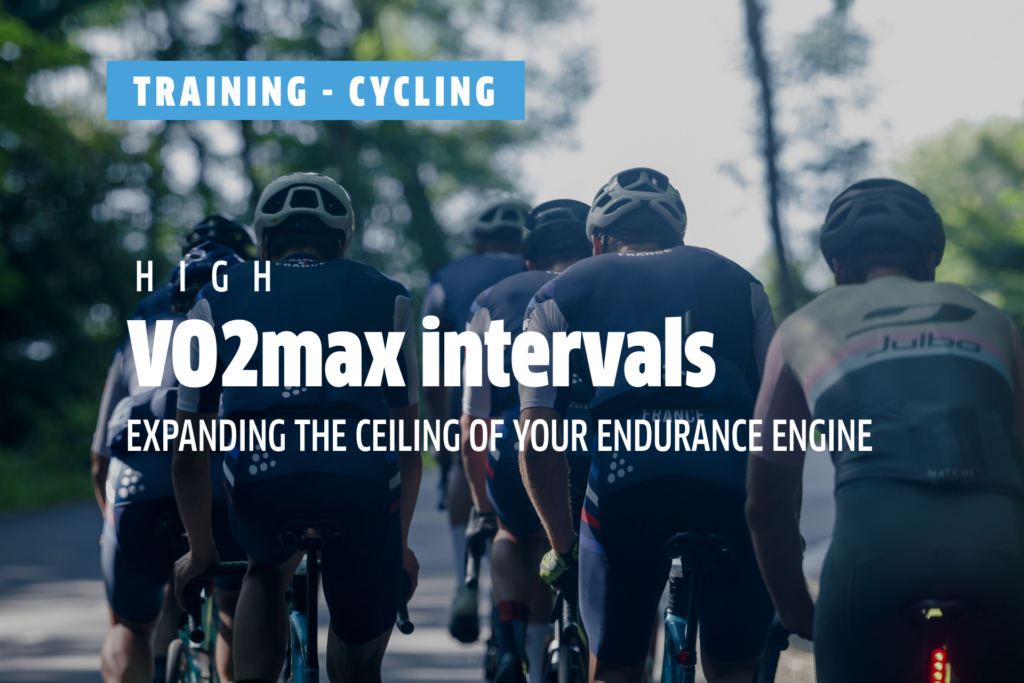
Your VO2max, the maximum volume of oxygen your body can absorb and use during intense exercise, is one of the strongest predictors of endurance performance. These short, intense intervals push you repeatedly to that ceiling, forcing your body to adapt and raise it over time.
Session facts
| Type | Intervals / VO2max |
| Duration | 75–90 min |
| Intensity | Very high (Z5) |
| RPE | 8–9 out of 10 |
| Terrain | Flat to rolling or steady climb |
| Structure | Warm-up / Main session / Cooldown |
| Frequency | 1 time per week, with at least 48 hours recovery before or after another hard session |
Training effect
VO2max intervals force your cardiovascular system to operate at or near its maximum oxygen uptake capacity, triggering powerful adaptations in heart stroke volume, oxygen delivery and muscular aerobic efficiency. For cross-country skiers, a high VO2max is not optional; it is the engine that makes everything else possible. Elite skiers consistently rank among the highest VO2max values recorded in any endurance sport, and developing this quality in the off-season through targeted cycling intervals is one of the most effective tools available without putting stress on skiing-specific joints and tendons.
Warm-up — 20 min
- 15 min easy spinning in Z1–Z2, building gradually
- 4 × 30 sec hard efforts at high cadence with 1 min easy between each, to prime the cardiovascular system
- 2 min easy before starting the main session
Main session — 35–45 min
- Ride 3 blocks of VO2max work with 4–5 min easy spinning between each block
- Option A — 30/15 intervals: 8–10 min per block of alternating 30 sec at maximal effort (Z5) and 15 sec easy. This format allows you to accumulate significant time near VO2max while the short recoveries keep quality high
- Option B — 40/20 intervals: 8–10 min per block of alternating 40 sec at Z5 and 20 sec easy. Slightly longer efforts that increase the challenge as fitness improves
- At RPE 8–9 on the hard segments, breathing will be maximal and speaking will be impossible — this is correct and expected
- On flat terrain, use a harder gear and higher cadence to drive intensity; on a steady climb, let the gradient do the work and focus on sustaining power
- Start with Option A if this type of session is new to you, and progress to Option B or longer block durations as fitness develops
Cooldown — 20 min
- At least 15 min of easy spinning before stopping — VO2max efforts place significant stress on the cardiovascular system, and an abrupt stop is not advisable
- 5 min stretching: quads, hip flexors, hamstrings and calves
Note: VO2max sessions are the most demanding in this series and should be treated accordingly. Arrive rested, fueled and focused. This is not the session to squeeze in after a long day or stack onto a tired week. It is also worth noting that VO2max work delivers the best results when used within a structured training plan; athletes who emphasize specific physiological qualities during different phases of the year will progress more effectively than those trying to include every session type every week. Done at the right time and recovered from properly, these intervals will lift your entire fitness ceiling, and that will show up everywhere, from the first climb of a ski race to the final kilometer.
Also Read
CYCLING TRAINING: Hill climb intervals – building the strength to power through every climb
CYCLING TRAINING: Sweet spot ride – the most efficient effort in your training week
Are you interested in training for Ski Classics, long-distance, traditional cross-country skiing, and biathlon? Click HERE and read more about it.
Subscribe to our newsletter
Most read
-
28.08.2026
-
-
14.09.2026
-
06.08.2026
-
06.03.2026



More Articles
-
Roller Ski World Cup: Complete program for Val Di Fiemme 2026
After the Roller Ski World Championships in Madona, Latvia, the 2026 Roller Ski World Cup season ends this weekend in Val Di Fiemme, Italy. Check the complete competition program here.17.09.2026