CYCLING TRAINING: Cadence and technique ride – smoother pedaling, stronger engine
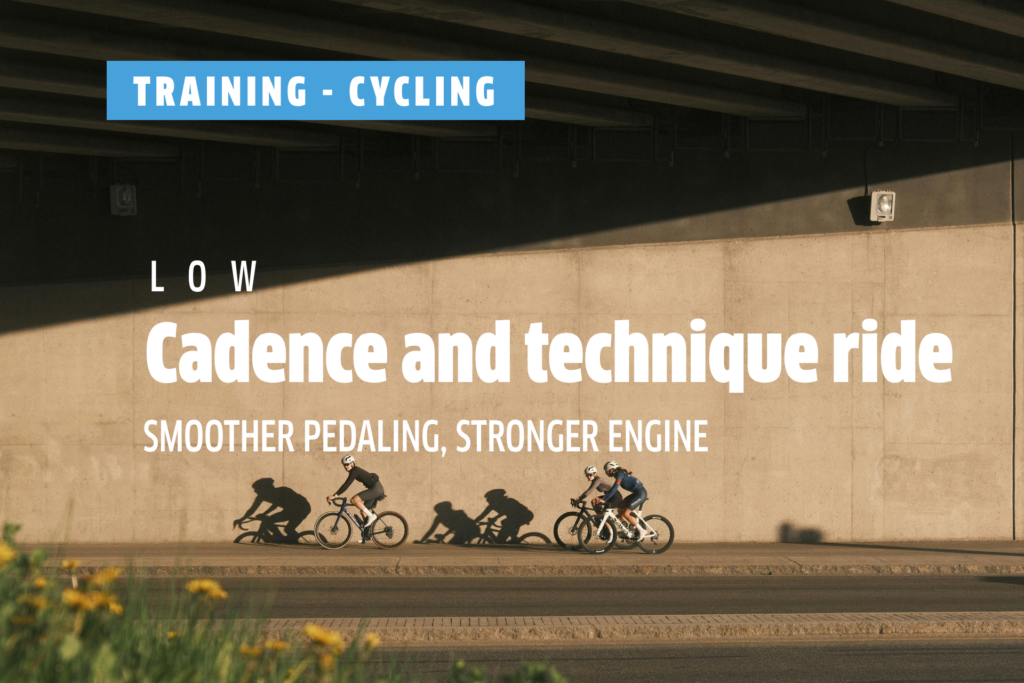
Efficient movement starts with the bike. This session uses structured cadence work to sharpen your pedaling mechanics, develop neuromuscular coordination, and build the smooth, economical output that makes every training hour count.
Session facts
| Type | Technique / Endurance |
| Duration | 60–75 min |
| Intensity | Low (Z1–Z2 cardiovascular, but neuromuscular demand can be significant) |
| RPE | 2–4 out of 10 |
| Terrain | Flat to gently rolling |
| Structure | Warm-up / Main session / Cooldown |
| Frequency | 1 time per week |
Training effect
This session trains neuromuscular efficiency, your body’s ability to move smoothly and economically under low load. The primary benefit is aerobic and coordinative: high-cadence work develops a light, quick leg turnover and sharpens pedaling mechanics, which can support more economical movement both on the bike and in other endurance activities. Rather than targeting a fixed rpm, this session encourages you to explore cadences above and below your natural preference, building a wider range of neuromuscular control.
Warm-up — 10 min
- 10 min easy spinning at a comfortable, self-selected cadence
- Gradually increase cadence toward 90 rpm by the end of the warm-up
- Keep effort very light — this is purely about waking up the legs
Main session — 45–55 min
- Ride 5 × 6 min with structured cadence variation within each rep: 90 sec at low cadence (around 60 rpm) followed immediately by 30 sec at high cadence (90–100 rpm), repeated 3 times per rep
- Take 4 min easy spinning between each rep
- Stay in Z1–Z2 throughout — use a light enough gear that the high-cadence segments feel quick and controlled, not forced
- On the low-cadence segments, focus on smooth, deliberate force through the pedal stroke — feel the difference in muscular demand compared to the high-cadence segments
- On the high-cadence segments, focus on a light, circular stroke — avoid bouncing in the saddle or tensing the upper body
- In the final 10–15 min, ride freely at your natural cadence and notice whether it has shifted
Cooldown — 10 min
- 5 min easy spinning, letting cadence drop naturally
- 5 min stretching: hip flexors, glutes and lower back
Note: Cross-country skiers often neglect technique work on the bike because cycling feels secondary to roller skiing or running. But the coordination gains from structured cadence work are real. The primary benefit is on the bike itself: smoother, more efficient pedaling, and that improved efficiency means more aerobic output for less energy cost. Think of it as investing in your movement quality, which pays dividends across all your endurance training.
Also Read – Cycling for skiers: A valuable tool for summer training
Are you interested in training for Ski Classics, long-distance, traditional cross-country skiing, and biathlon? Click HERE and read more about it.
Subscribe to our newsletter
Most read
-
-
14.09.2026
-
06.03.2026
-
16.09.2026
-



More Articles
-
Frida Karlsson prepares for home World Championships: “I hope to put on a show”
In 2015, she stood in the sea of spectators in Falun. Now the World Championships are returning – and double Olympic champion Frida Karlsson has one goal. She wants to put on a show.15.10.2026