Column: What did we learn from the Tour de Ski?
The 20th edition of the Tour de Ski is over. In one month, the Olympic Games will be decided on the same tracks. So, what did we really learn from the Tour de Ski with an eye on what lies ahead? Our Senior Editor, Kjell-Erik Kristiansen, sums up and reflects after the Tour in this column.
Tour de Ski is over. The 20th edition is history. In one month, the Olympic Games will be decided on the same tracks. So, what did we really learn from the Tour de Ski with our focus on what awaits?
Also Read – Where to watch the 2025/2026 winter season: traditional cross-country, biathlon and the Olympics
Klæbo – and the risk of a boring Olympics
Johannes Høsflot Klæbo made history. He took his fifth overall victory. He is becoming historic in almost everything he does right now. The risk is that the Olympic Games in Val di Fiemme could become quite boring because of Klæbo.
It is considered almost impossible to replicate the six gold medals he won at the World Championships in Trondheim last season. But given how dominant he is, he could also do it at the Olympics.
Norway’s luxury problem – which could become costly
Norway’s dominance on the men’s side has not diminished; quite the opposite. New names such as Mattis Stenshagen and Lars Heggen were thrown into the mix, while the reborn Emil Iversen was better than ever.
Norway could probably field three men’s teams at the Olympics, all of which would be better than, or at least on par with, the second-best team. The problem is that the Norwegian skiers are qualifying themselves to the point of exhaustion, risking arriving at the Olympics without peak form.
As many people say, what more does Emil Iversen have to do to be selected? Now he would need the time leading up to the Olympics to recharge, find new top form, and deliver the Olympics of his life.
Instead, he has to fight against Krüger, Fjorden Ree, and others in a brutally tough Norwegian Championships in Steinkjer. Let’s say, for example, that Fjorden Ree wins two national titles. Then the national team management will really have made a mess of things and created problems that could have been avoided.
Read More: Two new Norwegian cross-country skiers confirmed for the Winter Olympics 2026
Diggins – and the void she will leave behind
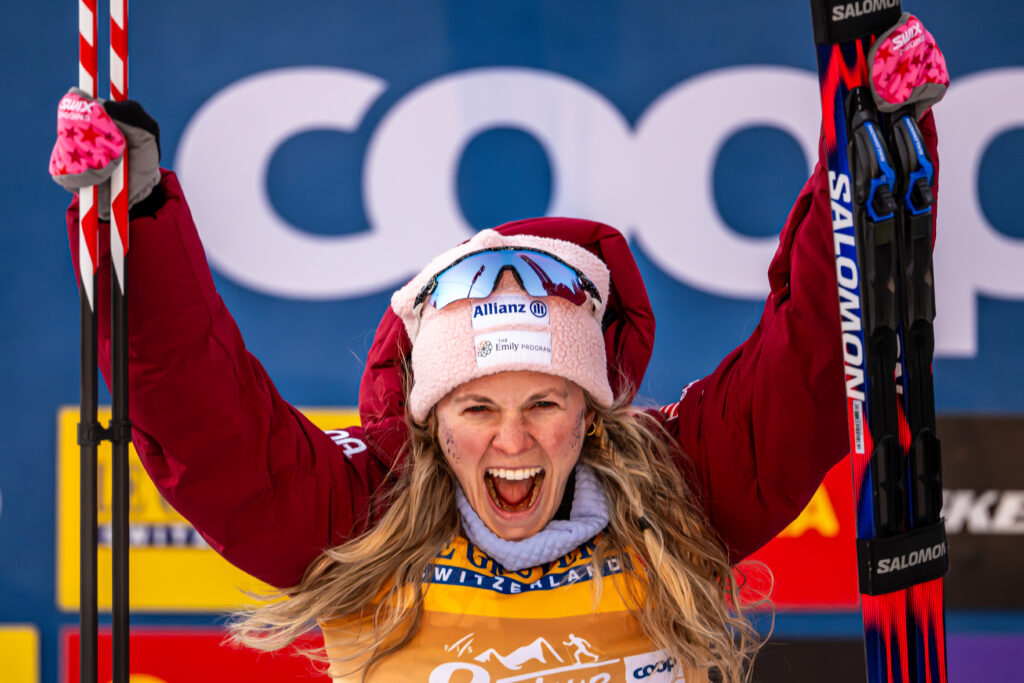
On the women’s side, Jessie Diggins is the star of the Tour de Ski. It is impressive how purposefully she works toward the goals she has set. She rarely complains, has a mindset most other skiers never experience, and a unique ability to dig deeper than anyone else.
But what happens when Diggins retires after this season? The depth of the U.S. women’s team is weaker than it has been in a long time.
Diggins will be dangerous at the Olympics, especially when the most formidable rivals on paper are showing signs of weakness. The Swedish team looks the most worrisome. Frida Karlsson and Ebba Andersson are both far from the form they had at the World Championships in Trondheim. There is little time to find it again.
Sweden’s best distance skier right now is Moa Ilar. She faded during the final stage of the Tour de Ski, and the 200 World Cup points she lost there could be enough to cost her the overall World Cup, for example, to Diggins.
The Swedes can, however, take comfort in having Jonna Sundling on home soil. If anyone finds top form for major championships, it is her.
The Swedish and Finnish crisis
There is, however, a crisis among the Swedish men. The worst Tour ever. The old master Torgny Mogren was criticized for saying it would be difficult to find eight Swedish men good enough for the Olympics.
But he has a point.
Jens Burman and Calle Halfvarsson are entirely out of the discussion. William Poromaa cannot find his form. And suddenly, a large part of the responsibility rests on the shoulders of Edvin Anger, who has never competed at the Olympics.
A small ray of light in the darkness: former junior world champion Anton Grahn stood on the podium in the sprint that was held on the upcoming Olympic course.
If it looks dark for the Swedish men, it is pitch black for the Finnish team. Stars such as Niskanen, Pärmäkoski, Hakola, and several others disappeared along the way. Until Jasmi Joensuu salvaged what could be salvaged with a sprint victory in Val di Fiemme on the penultimate stage, Finland had not taken a single World Cup podium this winter. It is hard to see how they will turn this around in one month.
Small nations, big moments
In the shadow of Klæbo and Diggins, there was still plenty to celebrate for nations that do not dominate as heavily.
Germany celebrated Coletta Rydzek’s second place in Toblach and Jan Stölben’s final appearance in Val di Fiemme. Otherwise, the German ranks are unusually thin.
Better news for neighboring Austria. Teresa Stadlober fought her way to second place overall and was close to stage victories. In addition, Benjamin Moser surprisingly stayed among the best in the overall standings for a long time. At the same time, star Mika Vermeulen was forced to withdraw.
The Italians will not be harmless on home soil. It is impressive how veteran Federico Pellegrino always manages to fight his way along. In addition, young Elia Barp is making substantial progress.
In the much-discussed mass start with heats, the relatively unknown Leonie Perry from France finished fourth, while Poland’s Eliza Rucka-Michalek set a personal best with sixth place. Canada’s Alison Mackie also recorded personal bests on the women’s side, and Britain’s James Clugnet finished in fifth place in the group start.
A new format – and political shadows
One novelty was the mass start with heats in Toblach. The five-kilometer race featured several nations in the lead. American Gus Schumacher took his second World Cup victory. But the format was unfinished and incomprehensible to many. The group allocation was random, conditions varied widely, and the TV production failed to display the time differences between groups clearly.
There was also a bit of politics. Especially when FIS’s new main sponsor, Azerbaijan, was visible both on bibs and around the stadium in Toblach. It is a highly controversial agreement. Azerbaijan is accused of human rights violations and is in constant conflict with neighboring Armenia over Nagorno-Karabakh.
Armenia’s Mikael Mikaelyan taped over the sponsor’s name and was fined by FIS. But I suspect the Ukrainians would have done the same if Russia had been the sponsor. For Mikaelyan, it was hardly an easy choice. Remember that this is also the main sponsor of the 2027 World Championships in Falun.
Russia was – at least partially – back in the fold. The two young skiers, Savelii Korostelev and Dariya Nepryaeva, delivered strong performances and escaped the worst media pressure. Most attention, however, went to their coach, Egor Sorin, who was present without accreditation and was chased by the media throughout the Tour.
Are you interested in traditional cross-country skiing? Click HERE and read more about it.
Subscribe to our newsletter
Most read
-
07.02.2026
-
28.05.2026
-
04.03.2026
-
05.06.2026
-
12.05.2026