RUNNING WITH POLES: Endurance session that helps strengthen your whole body
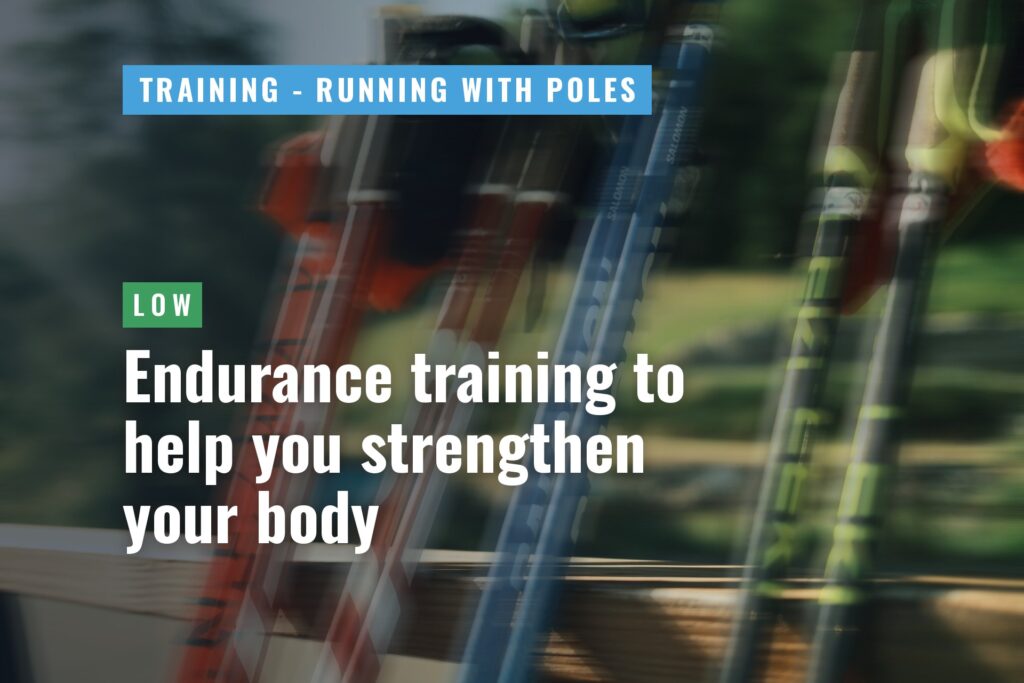
Endurance training builds a solid aerobic base that you can build speed on, and that lets you sustain effort for a long time.
Session facts
| Type | Endurance |
| Duration | 90–150 min |
| Intensity | Low |
| Terrain | Rolling |
| Structure | Main part / Stretching |
| How often | Once a week |
Session description
Jog easily on the gentler sections. On steep climbs, run or walk briskly and push off actively with your poles so that your arms, shoulders, and core work too. Keep an eye on your heart rate and stay in your aerobic zone (be especially careful on the climbs). The pace should be conversational.
If the steady pace gets boring, you can add the occasional short sprint of around 10 seconds on the flat.
Finish with some stretching to loosen up tired muscles.
Running with poles is easier on your musculoskeletal system than running without them. If you still can’t manage more than an hour of running, you can combine running with poles with a roller ski session.
Purpose of the session
The main goal of this session is to build your aerobic base – the body’s ability to work for a long time with a sufficient supply of oxygen. Long, low-intensity work leads to a range of adaptations: the heart’s stroke volume increases, the muscles gain more capillaries and mitochondria, and the body gets better at using fat as an energy source. As a result, you can handle a higher pace with less fatigue and recover faster between harder sessions.
The second goal is overall strengthening of the body. Hilly terrain loads the legs much like strength training, active poling engages the arms, shoulders and back muscles, and the whole movement strengthens your core. The long duration also gradually prepares tendons, ligaments and joints for a higher training volume.
Pole length
For running and hill bounding, use shorter poles than for skiing (roughly armpit to chest height, i.e. about 10–15 cm shorter than your classic poles). If you use long ski poles, you will overload your shoulders.
Be sure to bring light gloves to avoid blisters from the pole straps.
Also Read – RUNNING WITH POLES: Intervals to improve your functional capacity
Interested in training and training trends? Here you’ll find articles on training, training methods, research and development.
Subscribe to our newsletter
Most read
-
14.10.2026
-
-
22.10.2026
-
28.10.2026
-
29.10.2026





More Articles
-
Davos opens snowfarming trail and kicks off the cross-country skiing season
Cross-country skiers can once again click into their bindings in Davos. On Friday, October 30, 2026, the Swiss resort opened its snowfarming trail, a 4km loop made from snow that has been stored through the summer.30.10.2026