Drafting in skiing demystified
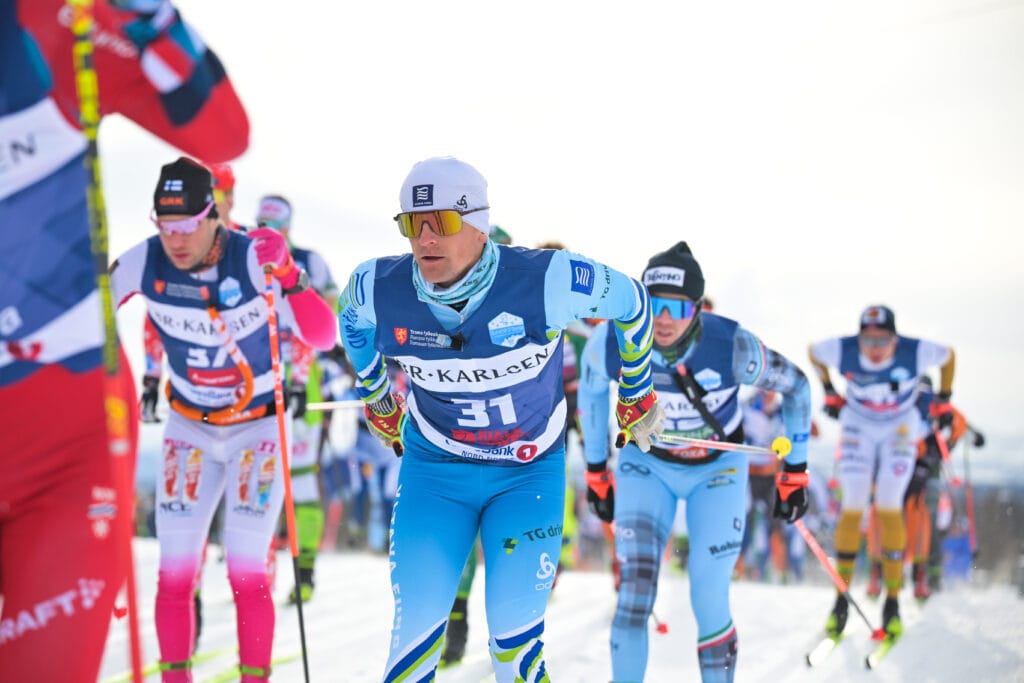
In competitive skiing, strategy can often determine the outcome of a race, particularly in a mass start. Pro Team athlete Fabián Štoček draws on extensive research from cycling, running, and skiing to highlight how drafting helps you to win or lose a ski race.
There are three main takeaways from this skiing article:
- The faster you go, the more drafting matters
- The best place to ski in a line of skiers is 3rd
- You can still benefit from drafting even if you’re not directly behind someone
Let’s now explain each of these points in detail.
The faster you go, the more drafting matters
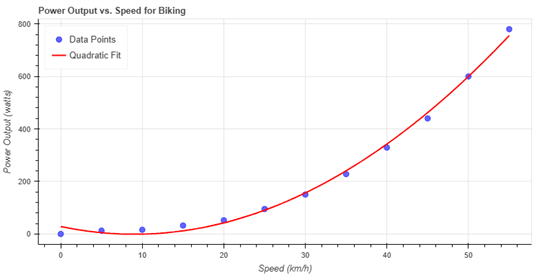
When you double your speed, air resistance increases by approximately a factor of four. Investigating the drag force formula, we can notice that the influence of the wind in the equation is squared, which is why aerodynamics matter so much more in cycling than in running. It’s also why you benefit the most from drafting at higher speeds in skiing. A good example to illustrate this is the amount of power (in watts) required to maintain the same speed while cycling on a flat surface without extra wind.
The best place to ski in a line of skiers is 3rd
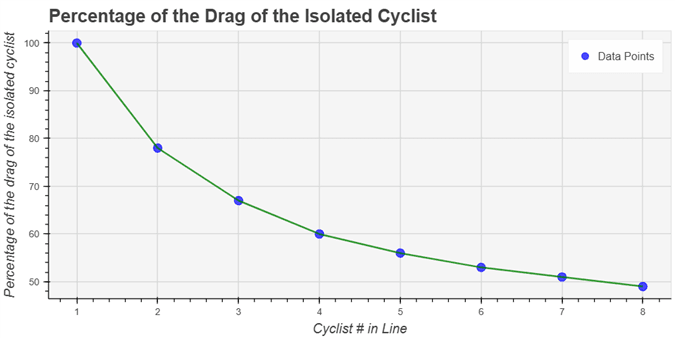
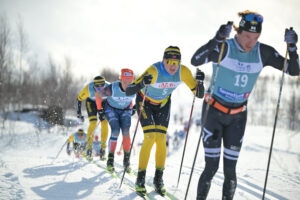
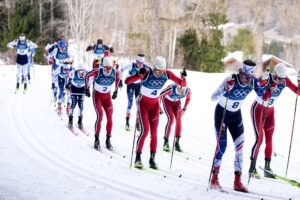
The optimal position in a line of skiers is third, where wind drag is significantly reduced. This advantage decreases only slightly in subsequent positions, but the ability to respond to attacks in a peloton also diminishes the further back you are. Skiers positioned farther back are also more likely to experience the “accordion effect” more acutely on undulating terrain, leading to significant variability in acceleration and deceleration as well as the likelihood of an accident, which consumes considerable metabolic power.
Again, we can draw parallels from cycling: wind tunnel research shows that the power saved decreases significantly from the second to the third position, with only marginal gains beyond that. This research, however, mainly covers cyclists riding in line. In larger groups, substantial gains are possible toward the back of the peloton, where up to 90% of power can be saved compared to a solo rider at speeds around 50 km/h. In skiing, a benefit from a peloton typically occurs only in large mass starts, such as many Ski Classics races or Worldloppet races.
Are you interested in Ski Classics and long-distance skiing? Click HERE and read more about it.
A skier 5 meters behind another skier is still benefiting from drafting
Even if this seems impossible to many, the way aerodynamics work has a very large influence on the amount of energy we need to dispense. In biking, the cycling federation has rules about where a camera motorcycle can ride around a biker. Research suggests that for bikers there are still some benefits even if a motorcycle is 20 or more meters in front of a biker. In running there are still relative power reductions even if running 5 meters behind another runner.
Interestingly, having a skier or runner behind the leader also reduces the drag on the front person. In skiing, the size of the athletes further influences drafting effects: a smaller skier benefits more from drafting behind a taller skier than vice versa. For example, a wind tunnel test on roller skis showed that a 1.57 m-tall female skier saved 10% of her metabolic power when following a 1.88 m-tall male skier, compared to skiing alone. This savings dropped to 5% when she followed another female skier. This highlights a substantial, often underappreciated advantage of drafting – and only some skiers know well how to exploit.

Other Variables Worth Considering
- Wind patterns can vary significantly, especially in open areas versus enclosed city settings, affecting drag differently.
- Not all skiers have the same frontal area or drag coefficient during the race.
- The lead skier often sets the cadence, which can influence the ski efficiency of those following.
- During sprinting, the sprinter’s gap can be utilized when a skier leaves the track behind another skier at the last minute in order to benefit the most from drafting and have a surprise effect advantage.
Key Takeaways
- Doubling your speed increases air resistance by approximately a factor of four, meaning drafting becomes increasingly beneficial at higher speeds.
- The optimal position in a line of skiers is third, where wind drag is significantly reduced. Further back, the reduction is only marginal, and it becomes harder to respond to moves in the peloton.
- A skier positioned 5 meters behind another skier still benefits from drafting.
References
Here is a notebook LM containing the references below, if you have more in depth questions feel free to ask us or the notebook. https://notebooklm.google.com/notebook/6a81c041-d5e0-4fd0-b354-cf6db7161049?_gl=1*2tpuoi*_ga*MzI0NTYxMjE4LjE3MzI1NTQwNjk.*_ga_W0LDH41ZCB*MTczMjU1NDA2OC4xLjAuMTczMjU1NDA3MC42MC4wLjA.
Here is also a podcast generated by notebook LM on this topic using the sources and highlighting the points in this article – https://notebooklm.google.com/notebook/6a81c041-d5e0-4fd0-b354-cf6db7161049/audio?pli=1
Seeberg, T. M., Kocbach, J., Wolf, H., Talsnes, R. K., & Sandbakk, Ø. B. (2023). Race development and performance-determining factors in a mass-start cross-country skiing competition. Frontiers in sports and active living, 4, 1094254. License: Creative Commons Attribution-Non Commercial-No Derivatives License 4.0 (CCBY-NC-ND)
Van Den Brandt, F. A., Khudair, M., Hettinga, F. J., & Elferink-Gemser, M. T. (2023). Be Aware of the Benefits of Drafting in Sports and Take Your Advantage: A Meta‐Analysis. Translational sports medicine, 2023(1), 3254847.
Ainegren, M., Linnamo, V., & Lindinger, S. (2022). Effects of aerodynamic drag and drafting on propulsive force and oxygen consumption in double poling cross-country skiing. Medicine and science in sports and exercise, 54(7), 1058.
van Druenen, T., & Blocken, B. (2023). Aerodynamic impact of cycling postures on drafting in single paceline configurations. Computers & Fluids, 257, 105863.
Blocken, B., van Druenen, T., Toparlar, Y., Malizia, F., Mannion, P., Andrianne, T., … & Diepens, J. (2018). Aerodynamic drag in cycling pelotons: New insights by CFD simulation and wind tunnel testing. Journal of Wind Engineering and Industrial Aerodynamics, 179, 319-337.
Blocken, B., Malizia, F., van Druenen, T., & Gillmeier, S. (2020). Aerodynamic benefits for a cyclist by drafting behind a motorcycle. Sports engineering, 23, 1-11.
Schickhofer, L., & Hanson, H. (2021). Aerodynamic effects and performance improvements of running in drafting formations. Journal of Biomechanics, 122, 110457. License Not an open source article – cannot use the graph or any data.
Subscribe to our newsletter
Most read
-
21.09.2026
-
14.09.2026
-
-
-
06.08.2026

More Articles
-
Hedegart considering quitting: “I have nothing to do here”
After his huge success as a cross-country skier, Einar Hedegart decided to return to biathlon. But now another career change may be underway.23.09.2026