Dundret Runt: the ski tradition that has become a true sign of spring in Gällivare
History
In Gällivare, Dundret Runt has become a clear sign of spring and a natural goal for many skiers. But how did it all begin?
At the first edition of Dundret Runt on April 11, 1965, 228 participants lined up at the foot of Mount Dundret. Already in its debut year, skiers could choose between two distances, 30km or 60km. The 60km racers started near Harrträsk, while the 30km participants took a cable car (!) to the top of Dundret before crossing the mountain down towards the Kelva checkpoint on the southern side.
The idea for the race came after a visit to Gällivare by legendary ski leader Gösta Frohm. He believed that the Swedish Outdoor Association should organize a recreational race around Dundret. “Dundret Runt – say it several times, and it becomes poetry,” he said. Soon after, the first edition was organized.
In 1969, the cable car up Dundret was used for the last time in the race. Extremely icy conditions caused chaos as participants tried to descend the mountain towards Kelva, leading to numerous injuries and broken skis and poles. The following year, a new course was introduced, but it was not well received by locals. “This is not Dundret Runt,” the skiers protested. In 1971, the 30km course was finally set in its current format, allowing participants to view Dundret from all directions.
Aid stations along the course also have a special history.

Food and drink stations have always played an important role in Dundret Runt and are key stops for recreational skiers. As early as 1965, organizers partnered with local companies to host the stations. A 30th anniversary publication from 1994 noted:
“At Dundret Runt, it is the goal itself – not the time – that matters. This also means that skiers take the time to stop and enjoy a well-earned break at the stations, creating a sense of camaraderie.”
That tradition lives on. Today, there are five stations on the 30km course and seven on the 50km course, where local businesses and organizations provide refreshments and a welcoming atmosphere on the way back to Hellner Stadium.
The races
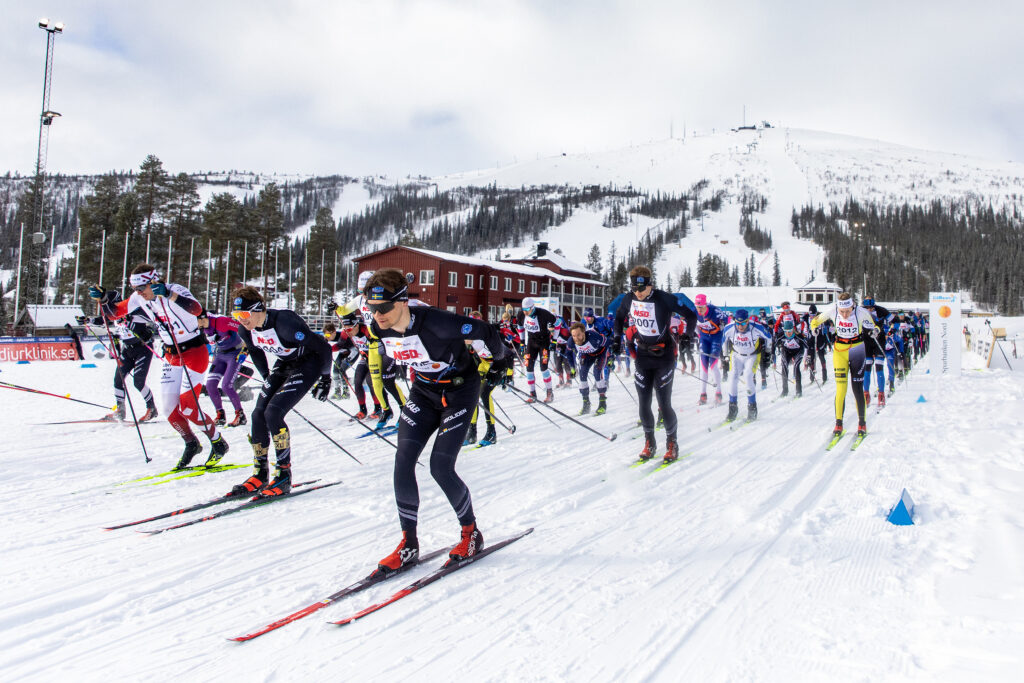
Since its start in 1965, Dundret Runt has been a recreational race without timing, and that tradition continues. The start window is between 07:00 and 09:00, with a mass start at 08:00. Participants ski around the mountain at their own pace – there is no need to rush. Along the course, you will find refreshment stations, cheering, and a great atmosphere. At 14:00, the cut-off is set at Porjusvägen, with 13km remaining to the finish.
13km
Introduced in 2025, the 13km distance starts with participants being transported by bus to Kelvajärvi. From there, a 1km transport section leads to the start near the XL Bygg/Colorama checkpoint. The course then continues over varied terrain to the finish at Hellner Stadium. With frequent aid stations, this race offers an enjoyable experience for participants of all ages.
30km
The 30km course is relatively easy and mainly follows the marshlands surrounding Dundret. After 10km, the food station – where the 50km course rejoins – is popular among both skiers and spectators. Here, fires are lit, and warm reindeer broth is served.
A few kilometers after the Malm checkpoint, the course features its only real downhill section, leading to the old meadow Tunturistavosjänkkä. After 17km, skiers face the climbs along Porjusvägen, a demanding challenge for many recreational skiers with nearly 20km already in their legs. Aid stations are frequent here, and after the final food stop, five easier kilometers remain to the finish at Hellner Stadium.
50km
The long Dundret Runt was originally 60km and widely considered very demanding, often compared to Vasaloppet despite being shorter. Today, the course has been shortened to 50km (47km to be exact), but it remains a serious challenge.
After 10km of double-poling along Harrträsk and across vast marshlands, skiers reach the second checkpoint at Renforskningen. At this former research station, the Swedish University of Agricultural Sciences conducted research on emergency feeding of reindeer. Here, participants are refueled with blueberry soup and sports drink.
The most demanding section follows, with long climbs over the Kuolpa Pass. The next major challenge comes halfway through the race: the ascent of Saivovaara, a long, steady climb along a boundary line. After Saivovaara, a well-earned 1km descent leads back to the 30km course, where skiers are rewarded with warm reindeer broth.
More information about the event can be found HERE
Subscribe to our newsletter
Most read
More Articles
-
Five training sessions to develop your double poling technique
Five training sessions designed to help you develop and improve your double poling across skiing, roller skiing, and the gym.21.09.2026