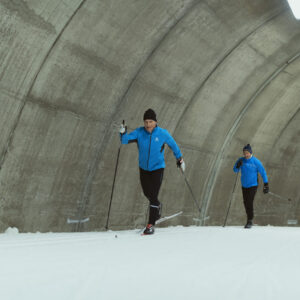
Thought he had fallen – suffered a stroke during training

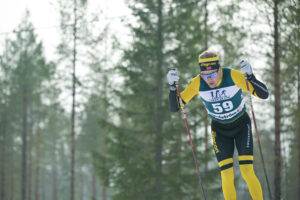
It happened the day after the Moraloppet. In the middle of a sprint during a training session, Emmanuel Elmersson suffered a stroke. Now, he’s fighting to return to the ski tracks.
Over the past year and a half, Ski Team Göhlins has been hit by two serious incidents. After finishing the 2024 Birkebeinerrennet, Pro Team Director Simon Jonsson suffered a cardiac arrest. And during a training session the day after Moraloppet, Emanuel Elmersson had a stroke during a sprint.
Now, the Småland native shares the story of the training session in Mora that changed his life.
Also Read: The heart stopped for 12 minutes – now he’s training again
In the middle of a sprint
On Saturday, January 18, 2025, Elmersson competed in the Moraloppet, finishing in 26th place. The next day, several of his Ski Team Göhlins teammates went out for a training session between Hökberg and Mora.
“There was supposed to be another race on Sunday, but it was canceled due to a lack of snow. Still, we stayed in Mora, and the next morning was just a regular morning. We had breakfast and then said we’d go out for an easy two-hour session on the Vasaloppet course before heading home to Småland,” he told Langd.se.
On the way back from Hökberg, some of the athletes did short sprints.
“We were doing some sprints, and it happened during one of my last ones. For some strange reason, I just collapsed. I was conscious the whole time and thought I had simply fallen for some odd reason. But it turned out that at that very moment, I had a stroke – I planted my pole tip on the ski and fell down.”
Landed in a snowdrift
Initially, no one realized the seriousness of the situation. But when Emanuel tried to get up again, he knew something was wrong.
“I tried to get up and ski on – some of the others had gone a bit ahead. But I had no control over my body. It felt like my hand was stretched out in the air, but the pole was lying on the ground.”
Some of the skiers hadn’t been sprinting and arrived about 30 seconds later. They found Emanuel in a snowdrift.
“I thought everything was fine. My head just felt dizzy and off. I told myself, ‘I just need to get up, it’s fine.’ But I quickly realized that the more I tried, the dizzier I got. They tried to calm me down. I just felt it was exhausting.”
Didn’t understand the seriousness
At that point, his teammates called emergency services, realizing something was clearly wrong. Emanuel began to notice that his arm wasn’t responding properly, and he started repeating certain things. In the ambulance, the entire right side of his body had gone numb – but even then, the 33-year-old didn’t understand how serious it was.
“I thought I just had a concussion,” he said.
He was first taken to Mora Hospital, where he praised the medical team.
“The first four hours are really critical. The medical team and nurses were fantastic. I was very calm, and they took care of me immediately.”
Released after a week
He was later transferred to Uppsala and eventually to Värnamo. After a week, his condition started to improve, and he began to regain sensation. What he struggles with most now is brain fatigue, something he’s still learning to manage nearly six months after the stroke.
“What I mostly suffer from today is brain fatigue.”
Do you feel any fear after the incident?
“Of course, it makes you reflect, but I feel that with the blood-thinning medication I’m on, it should help. Still, when the cause remains unknown, there are some lingering questions,” Emanuel explains.
Hoping for a comeback
Do you think you’ll return to skiing?
“In some way, I hope so. It would be a victory just to stand on the start line of a race early next year. It would be amazing to line up for Vasaloppet.”
First, Emanuel will need to take it easy for six months, followed by a series of tests with a sports doctor to determine if he’s ready for more intense training.
“After that, you have to be realistic about how much you’ve lost. You probably can’t have too high expectations once you’re back on the start line,” he concludes.
Are you interested in long-distance skiing? Click HERE and read more about it.
Subscribe to our newsletter
Most read
-
11.05.2026
-
19.09.2026
-
24.09.2026
-
01.03.2026
-
26.08.2026

More Articles
-
Swedish and Norwegian cross-country ski tracks open: Early snow guarantee for 2026
This weekend, several traditional Swedish and Norwegian destinations are launching their early snow offers. Here is an overview of destinations with snow guarantees.22.10.2026