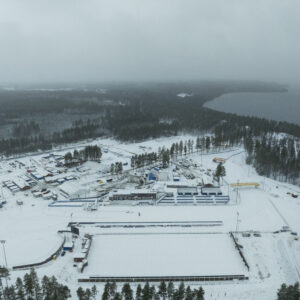
Marit Bjørgen’s journey to becoming the World’s best winter sports athlete

Marit Bjørgen, a name synonymous with excellence in winter sports, recently unveiled the secret behind her illustrious two-decade-long career during the Norwegian Olympic Research Conference.
With a staggering collection of 15 Olympic medals, including eight golds and 18 World Championships golds, Marit Bjørgen’s journey to becoming the best in the World has been nothing short of remarkable.
At the heart of her incredible success is an unyielding work ethic. Throughout her 19-year career on the elite national team, Bjørgen logged an astonishing 14,300 hours of training, averaging around 800 hours annually. Her training regimen evolved from 500 hours in her early years as a senior to a peak of 950 hours per year.
Reflecting on her dedication, Bjørgen emphasized, “Success requires hard work over time. Many athletes have trained more than me, but it’s important to find what suits each individual.”
Her training hours increased progressively, starting at 350 as a junior and peaking at 950 when she achieved remarkable success even after giving birth, reducing her training hours by 25 percent.
“As a junior, I trained 350 hours, while I trained 500 hours as a first-year senior. When I won my first World Championship gold at the age of 23, I trained 700 hours. At 29, I had a turnaround with up to 950 hours a year. Then I won six gold medals from two championships after giving birth and reduced the amount of training by 25 percent,” says Bjørgen.
The sheer volume of training didn’t solely mark Bjørgen’s journey. Her approach evolved significantly throughout her career. At one point, she incorporated intense, hour-long sessions aimed at increasing her capacity, which propelled her to the top of the skiing world.
This shift also saw her transition from a sprint specialist to a dominant distance skier. Yet, her ascent to greatness was punctuated by a challenging period from 2006 to the 2010 Olympics in Vancouver, during which she grappled with poor form and underperformance. This challenging phase took a considerable toll on her, both physically and mentally. It was a turning point in her career when she realized she needed to take ownership of her development and refocus her goals on competing for Olympic medals.
According to Langrenn.com, the pivotal change in her training approach came when Bjørgen abandoned high-intensity intervals and frequent intensive sessions in favor of lower-intensity volume. The new regimen saw her incorporating two to three hard sessions per week at moderate intensity. This strategic shift ultimately revitalized her career.
Beyond her unwavering dedication, Bjørgen possessed an intangible X-factor that allowed her to weather the highs and lows of her career. She also managed to balance her sporting pursuits with a broader perspective on life. Family played a significant role in her journey, as she received support from her loved ones. This backing, including her partner Fred Børre Lundberg’s commitment to help her maintain her training routine was invaluable. She credited Olympiatoppen for providing guidance on her training and the Norwegian Ski Association for their support, which allowed her to participate in competitions and included arrangements for her family.
Marit Bjørgen’s incredible journey culminated in her becoming the most successful Winter Olympian of all time, as she secured four medals at the 2018 Olympics. Her story serves as a testament to the extraordinary dedication, resilience, and unwavering support that can lead to the pinnacle of winter sports.
Are you interested in traditional cross-country and long-distance skiing training? Click HERE and read more.
Subscribe to our newsletter
Most read
-
12.11.2026
-
17.11.2026
-
-
14.10.2026
-
22.10.2026


More Articles
-
Program, start lists and start times for Thursday
Today, Thursday, the 2026/2027 biathlon season gets underway with the World Cup opener in Kontiolahti (Finland) and the IBU Cup opener in Idre Fjäll (Sweden). In cross-country skiing, the French season opens with a freestyle sprint in Bessans (France). Get to know the program, start lists and start times.26.11.2026