Ammunition for biathlon: Precision under pressure

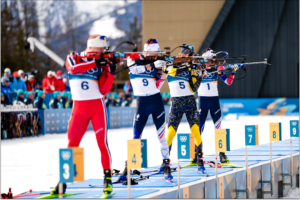
In biathlon, every shot counts. While skis, wax, and fitness often capture most of the attention, the small .22-caliber cartridge fired in each race can determine the difference between a clean shooting bout and a costly penalty loop.
Selecting, testing, and understanding ammunition is an essential part of the sport’s precision side — one that combines physics, consistency, and discipline.
The standard caliber: .22 long rifle
Since the late 1970s, the International Biathlon Union (IBU) has standardized the .22 Long Rifle (5.6 mm) rimfire cartridge for all official competitions. This smallbore ammunition strikes a balance between accuracy, manageable recoil, and safety when used on 50-meter ranges under winter conditions.
Unlike larger calibers used in military or hunting contexts, .22 LR operates with relatively low energy. Yet in biathlon, it must remain precise through wind, snow, and cold temperatures that can drastically affect performance.
IBU rules and specifications
Ammunition used in IBU competitions must follow strict parameters designed for fairness and safety:
- Caliber: .22 Long Rifle (5.6 mm rimfire)
- Bullet weight: between 2.55 g and 2.75 g
- Muzzle velocity: not exceeding 360 m/s (measured 1 meter from the muzzle)
- Range distance: 50 meters
- Maximum impact momentum and safety standards as defined in IBU technical regulations
Each athlete must use the same type of ammunition throughout the competition and comply with all equipment inspections and range safety checks.
Also Read – Biathlon World Cup: Calendar for the 2025/2026 winter season
The story continues below.

Cold weather and ammunition performance
Ammunition performance is highly sensitive to temperature. Cold powder burns slower, producing slightly lower velocities and potentially shifting the point of impact. That’s why top athletes and technicians spend hours conducting “cold tests” — firing their chosen ammunition outdoors at realistic race-day temperatures to ensure consistent grouping and zero.
Even small velocity changes of 5–10 m/s can alter shot placement enough to miss a 45-millimeter prone or 115-millimeter standing target. For this reason, teams often dedicate entire testing sessions to finding the most stable lot number for their rifles under cold conditions.
Match-grade and biathlon-specific loads
A few manufacturers produce biathlon-dedicated .22 LR ammunition, such as Lapua, Eley, RWS, Norma, SK, and Fiocchi. These match-grade cartridges are optimized for:
- consistent ignition in freezing temperatures
- uniform velocity from shot to shot
- minimal variation in bullet lubrication and case dimensions
While standard “match” ammunition also performs well, biathlon-specific loads typically use softer lubricants and carefully balanced powders to maintain performance at temperatures as low as -20°C.
Teams typically purchase ammunition in large quantities from a single lot number. Each rifle behaves slightly differently, so athletes test multiple lots to find the one that groups most consistently — and then purchase enough for the season.
Safety and logistics at events
Transporting and storing ammunition follow strict protocols. Teams typically sign rifles and ammunition in and out of secure storage at the venue and use them only within the designated biathlon range.
Each team maintains detailed logs matching rifle serial numbers and ammunition lot numbers for every athlete — procedures designed to ensure both safety and full compliance with IBU procedures.
Read More: Program for biathlon at the Milano-Cortina 2026 Winter Olympics
The story continues below.

Environmental considerations
Across Europe, regulators are reviewing the use of lead-based ammunition, including rimfire cartridges. Although lead-free .22 LR alternatives are in development, few currently meet the precision and reliability standards required for elite biathlon. Manufacturers and national federations are working toward sustainable solutions that maintain the sport’s hallmark accuracy.
A matter of precision and confidence
In a sport where heart rate, breathing, and nerves are already difficult to control, reliable ammunition provides a crucial layer of confidence. For biathletes, shooting clean is not only about skill — it’s also about knowing that every cartridge will behave precisely the same, even in the harshest winter conditions.
Are you interested in biathlon? Click HERE and read more about it.
Subscribe to our newsletter
Most read
-
27.08.2026
-
20.02.2026
-
03.08.2026
-
30.09.2025
-
15.02.2026

More Articles
-
Ruud Lia and Castagna claim junior sprint wins in Val di Fiemme
The Junior Roller Ski World Cup in Val di Fiemme continued this Saturday, featuring a freestyle sprint event in Italy. Check out the junior results.19.09.2026