Recovery – Part 3b: hot water and contrast therapy

A series of articles on recovery has been published on ProXCskiing.com. Part 3 of the series (3a) started with cold therapy, and this sequence looks at the effectiveness of hot and contrast therapy in optimizing recovery.
Recovery – Part 3b: Hot and contrast therapies introduce the reader to hot water therapy and hot/cold combination therapy, or contrast therapy. The Maastohiihto.com article also presents the optimization of recovery.
Hot
In hot water therapy, the water temperature is often at least 36 degrees Celsius, and the immersion time ranges from 10 to 24 minutes. Studies have yet to find clear benefits, though not harms, from hot water therapy. However, hot water therapy is generally not recommended for endurance athletes, especially for recovery after long periods of exercise in hot conditions, as the body temperature can rise too high if the body, which has been heated during exercise, is immersed in warm water.
The benefits of heat are more significant for power sports athletes, where muscle warmth prevents the development of tears. Similarly, long endurance runs in cold conditions, especially at sub-maximal power, may even cause mild hypothermia, in which case warm water may be beneficial.
As for the sauna, which is familiar and beloved to Finns, one study suggests that taking a sauna (90°C, 10% humidity) after half an hour of endurance exercise may reduce the formation of free oxygen radicals in the body and thus prevent oxidative stress. Further, it is worth noting that heat exposure is not a good idea when post-exercise body temperature is elevated, and fluid loss has possibly occurred. In this case, a better option would be cold therapy or neutral-temperature water, which is the next step.
Mild
Thermoneutral water therapy is when the water used in the treatment is around 35 degrees Celsius and does not change the body temperature. However, the range of temperatures used in studies is often more comprehensive because they have used swimming pools as a thermoneutral environment when the water in a swimming pool is often somewhat cooler, around 26-28 degrees Celsius. The duration of the therapy is often 15-30min. However, unlike other forms of aquatic therapy, in lukewarm water, you are not always passively lying still but maybe doing some light aerobic exercise such as swimming, running, or stretching.
The results of studies on the benefits of thermoneutral water for recovery could be more consistent. An interesting finding is from a study that tested triathletes’ recovery after a hard running session. The intervention group performed a 45-60 minute hard interval workout with swimming ten hours after the running intervals. Compared to the control group, triathletes who performed hard interval swimming improved their running performance 24 hours after the end of the training.
Aerobic, especially light-intensity recovery exercise, may, therefore, at least according to some studies, serve as a recovery-enhancing form of exercise. This information has already been exploited by several athletes who regularly incorporate recovery swimming or water running/jogging into their training program. On the other hand, it is also worth considering the risks of aquatic training. Since water puts little strain on joints and tendons and may even enhance recovery, athletes may become over-enthusiastic. This can lead to an insidious, almost unnoticed, overload in the long term.
Cold and hot together?
When cold and hot are combined in a single therapy, you get contrast therapy, more commonly known as cold-hot therapy. Contrast therapy involves alternating between hot and cold water, often by spending the same amount of time (1:1) or less time (2:1) in the cold than in the hot.
One study found that contrast therapy may reduce perceived fatigue compared to active or passive recovery. However, despite lower heart rate and blood lactate levels, contrast therapy had no more effect on performance than active/passive recovery.
In another study, cycling performance improved after contrast therapy compared to passive recovery. Subjects cycled 75 minutes in a timed manner, recovered for two hours, and repeated the 75-minute session. Contrast therapy consisted of a 6-minute, 12-minute, or 18-minute treatment, alternating between cold (14.6°C) and hot (38.4°C) water with 1 min (1:1) in each temperature. The contrast therapy group improved the cycling performance (total work and maximum power). Still, the duration of therapy was not relevant, and thus, no dose-response relationship was observed with the treatment.
The same team of researchers repeated the study with runners, using the same formula but now with a 3000m race + 8x400m intervals, a two-hour recovery, and finally, a 3000m race. Like the cyclists, the runners also showed that 6 minutes of contrast treatment improved performance compared to the control. Other studies have also found that cold water therapy and contrast therapy work better than hot water therapy or passive recovery, even in elite endurance athletes.
The difficulty of choice
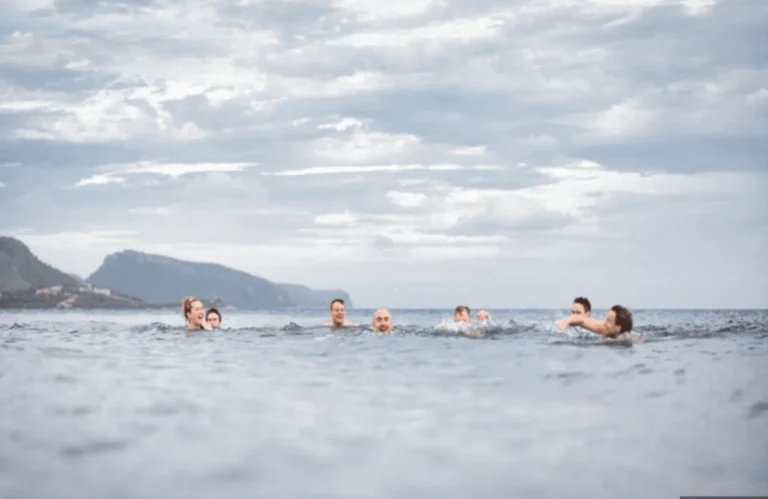
So, which of the above forms of aquatic therapy should an athlete choose? Do I jump into the pool to splash around, or is cold lake water a better option? Or that nice warm jacuzzi in the swimming pool?
The choice of water temperature depends on a few factors: the type of sport/exercise (eccentric vs. concentric) and its characteristics, and what the athlete is looking for from the water. Is it to enhance recovery, reduce potential muscle damage or soreness, or relax after a hard workout?
A few studies have compared cold, warm, and contrast therapy in sports. The results show that cold water and contrast therapy are more effective in promoting recovery than warm water and thermoneutral therapy. The results also showed that the benefits of these forms of hydrotherapy are likely to be greatest after muscle-damaging exercises, such as running with eccentric damage, compared to cycling, where the movement is mainly concentric, and muscle damage is, therefore, less severe. Runners and orienteers may benefit more from hydrotherapy than cyclists and cross-country skiers.
Optimal recovery or optimal training response?
Recently, there has been much talk about optimizing recovery and training adaptation. According to some theories, to complete recovery, for example, by consuming a recovery meal immediately after training or by cold-treating muscles, could even hinder optimal development. The idea behind this theory is that when the body is stressed, and minor damage occurs, it should be allowed to repair itself, thus potentially maximizing the training effect.
What, then, about cold water therapy? For example, should it be used after exercise, or do cold baths block any training response? Nobody knows the answer to this question yet, but there has been and will continue to be much discussion on the topic. The following are some of the recommendations that could be made to an athlete:
– When the training season is underway and the shape and sensations (whether or not there is fatigue in the body) are not so important (i.e., there are no competitions in the near future), it might be advisable to avoid cold baths to a lesser extent, at most after individual hard training sessions or when there is only a short recovery period between training sessions. In this case, the training effect may be enhanced, and development accelerated.
– On the other hand, if it is essential to perform high-intensity exercises as frequently as possible, as is the case with block training, for example, enhancing recovery may improve the training effect by enabling a high-quality workout.
– As the competition season approaches, when legs should feel fresh and when muscle pain and fatigue may hamper performance and optimal training, for example, to reach or maintain a certain pace, you can use cold therapy (or even contrast treatment) to promote recovery. Regarding races, it doesn’t matter who has the highest levels of PGC-1α and who doesn’t; what matters is the performance itself, and that’s something to nurture, if anything, as the race approaches.
Read the first part of this article here – Recovery – Part 3a: Cold Therapy
References
Halson et al. Does hydrotherapy help or hinder adaptation to training in competitive cyclists? Med Sci Sports Exerc. In press.
Halson. Recovery techniques for athletes. Sports Science Exchange 26(120), 1-6.
Menetrier et al. 2013. Effects of recovery using contrast water therapy or compression stockings on subsequent 5-min cycling performance. J Sci Cycling 2(2), 49-56.
Versey et al. 2013. Water immersion recovery for athletes: effect on exercise performance and practical recommendations. Sports Med 43, 1101-111130.
Subscribe to our newsletter
Most read
-
08.08.2026
-
17.07.2026
-
10.07.2026
-
-
08.07.2026


More Articles
-
Recovery – part 3a: Cold therapy
Do you have the habit of jumping into a lake to cool off after a sweaty run in the summer? Or you run from the sauna into a snowdrift during winter. If you answered yes to either of these, you may have unknowingly been aiding your recovery from workouts.25.08.2026