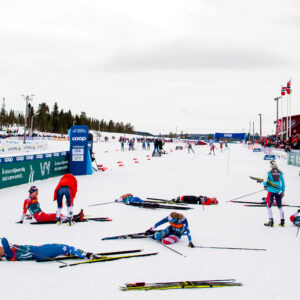
Intervals vs. Speed Endurance – Which develops more?

In this article, let’s return to the topic and consider whether high-intensity speed workouts develop best as steady-state or interval sessions for different individuals, and what kind of intervals should skiers do? We asked Ville Vesterinen, an expert in sports physiology working at the Research Center for Competitive and High-Performance Sports.
Intervals vs. speed endurance is often a difficult question for skiers when considering their intensity training. Should the focus of intense training be on steady-state speed endurance workouts or various interval training? Or should both be done equally?
Research evidence on this topic is mainly available from group-level differences between intervals and steady-state workouts. However, there is practically no research evidence on the individual suitability of intervals versus steady state. High-intensity interval training (HIIT) versus steady-state speed endurance training has been well-researched at the group level, with differences found according to Vesterinen.
“High-intensity interval training is more effective if we think about the development of maximal oxygen uptake and performance. Studies have also found that individual variation is large in the response to high-intensity training. There are people who do not improve much, while others improve a lot. The reason why some improve, and others do not is very scant. That information is required to say whether someone develops better with steady-state or intervals, Vesterinen says to Maastohiihto.com.
In his doctoral thesis, Vesterinen specifically studied individual variation in the productivity of endurance training. It looked at the differences between volume-weighted low-intensity training and high-intensity training individually. Both groups had both very well-developed and not-so-well-developed individuals.
“High-intensity training naturally develops maximum oxygen uptake and maximal characteristics. When we looked at factors explaining development in these endurance athletes, we found that age or fitness level, for example, had no connection to development. The strongest explanatory factor was resting heart rate variability. Those who benefited most from high-intensity interval training had higher resting heart rate variation. Conversely, those who benefited from low-intensity training had lower resting heart rate variability. For those who benefit from low-intensity training, low-intensity training is sufficient to cause a training stimulus. They did not benefit as much from high-intensity training because it can be too burdensome,” Vesterinen says.
In high-intensity intervals, one can move longer at higher intensities because there are recoveries in between. Through this, maximum performance is easier to develop than with steady-state workouts. In interval-type and fast-paced sports, performance development is then easier with intervals than with steady-state.
“Steady-state is better suited if the athlete is preparing for long performances such as marathons or long-duration mass skiing,” Vesterinen says.
“For recreational enthusiasts, steady-state training is usually speed endurance training and a good form of exercise, while more fit individuals may require more intense interval workouts.”
Short intervals ready for modern skiing
Interval training, on the other hand, has been compared in recent Norwegian studies between short intervals and traditional, longer intervals.
“Often, 3–5-minute maximum endurance intervals are considered the best at producing a training response, but newer studies have examined short 30-second intervals. For example, 3x13x30 seconds with a short 15-second recovery can produce an even better response. In these, one can move at higher intensities and oxygen consumption does not decrease during recoveries. One of the most important things for the development of maximum oxygen uptake is that oxygen consumption stays near maximum level as long as possible during training,” Vesterinen says.
The topic is closely related to what has been widely discussed in Finnish skiing lately: the need to be faster. Ski Classics and cycling coach Mattias Reck advocates 40-second bursts with 20-second recoveries, often done in series as part of intense speed endurance training or during long double-poling sessions.
“Shorter intervals serve better when moving at higher intensities. Skiing as a sport is such that shorter intervals can provide more readiness for the body to perform short spurts, even when under a moderate load. This helps prevent too much oxygen debt during breakaways,” Vesterinen says.
In Finland, endurance training is traditionally programmed so that the most is low-intensity training, followed by speed endurance training, and then high-intensity training. For example, in Norway, the polarization of training is more common, meaning endurance training is mainly focused on low-intensity training and the other extreme, high-intensity training.
“Studies also support that polarized training is slightly more productive. In high-intensity workouts, perhaps short intervals are something that will become more common. They allow even faster movement speeds,” Vesterinen says.
“The debate on ‘Intervals vs. Speed Endurance’ will continue in the future, and everyone should try out which methods best suit their own training and how receptive their own body is to different intensity workouts.”
The article was originally published in February 2020 and updated today. Read more training-related articles HERE on ProXCskiing.com website.
Subscribe to our newsletter
Most read
-
08.08.2026
-
17.07.2026
-
10.07.2026
-
08.07.2026
-
23.07.2026



More Articles
-
Never competed internationally – now he’s outshining the stars
Sturla Holm Lægreid is one of the world's most accurate biathletes, and Martin Uldal is among the fastest. None of them came close to Sivert Bjørndalen in his season debut.23.08.2026