Coach Of The French Women’s National Team: Alexandre Pouyé

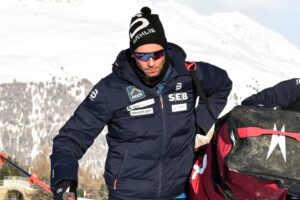
Alexandre Pouyé is a former cross-country skier and now the women’s French National Team coach for the first time. Today at ProXCskiing, we talk with Pouyé about his background and the women’s summer training, their preparation, and their goals for the upcoming winter.
Alexandre, can you introduce yourself and explain to us your background?
“I’m from a small valley at the bottom of the Savoie, the village of Peisey-Vallandry. I am 29 years old and the coach of the women’s World Cup group of the French cross-country skiing team. I was an athlete and in the French teams for seven years and a guide for a blind athlete for three years. Now, I am finishing a master’s degree in coaching at the Grenoble Campus.”
As you said, you were an athlete yourself. What does it bring to you today as a coach?
“If my studies have given me some theoretical knowledge on training, my experience as an athlete has given me empirical knowledge. One cannot go without the other. I think that the knowledge of the terrain, the equipment, the handling of stress, and a lot of other things like the codes to respect in this environment come from the experience as an athlete. A few situations I encounter as a coach remind me of my experiences as a competitor. So, I try to save them time by not making the same mistakes I did!”
You are the women’s coach this year, and it’s the first time you have been a coach for a women’s group. How is it going?
“It’s going very well, and we had a lot of individual talks in the spring to get going in the right direction, taking into consideration the way each one works.”
How is the preparation going? How many training camps did you already have?
“The preparation is going smoothly for the moment. We have done three big training camps since the beginning of the preparation and a few small camps between them. After a tough winter for everyone, with the covid and the Olympics Games, everyone needed a good break, so the athletes returned to training on their own. Then there were two weeks in Tignes to launch the team. This summer, we went to Norway twice to participate at Blinkfestivalen and Toppidrettsveka, to have good training camps up there and compete against the best in the discipline.”
What are the plans for this fall? Do you plan to go on altitude training camps? Knowing the World Championships are not in altitude, do you think altitude training is a good choice for this season?
“This autumn, we will have three long training camps. The first one will be in Corrençon en Vercors, focusing on high-intensity work. Then we will go to Ramsau particularly to get back the snow feeling. The final training camp will be in Davos. It is clear that with three weeks in Scandinavia at the beginning of the season and the World Championships in Planica, training at altitude (Tignes and Ramsau) is more a way of making changes to the physiological level than preparing specifically for very high intensities at high altitudes like last year. It remains an interesting work, and it is just necessary to consider in the planning that the competitions will not be very high.”
Were you together in training camps with the men’s groups?
“We are always in training camp with both men’s groups (sprint and distance), except for the September camp, where we all go to different places. I think it brings something to everyone to be all together.”
The whole group seems to be in good shape regarding the great performances in Blinkfestivalen and Toppidrettsveka. Was it the big goal for this summer?
“They were not big goals in terms of results, but they were goals of confrontation to be able to orientate the work on the main weakness of each during the autumn. Obviously, we avoided doing extremely difficult sessions the day before to have good sensations at the start, but we didn’t prepare for the races more than that. Until then, we didn’t work much on the ability to go very fast in a sprint, so the rather average results in the sprints were not a surprise.”
Do you have other competitions planned for this fall?
“We will compete at the Rollerski French Championships in early October. Otherwise, we will do small internal races.”
Your athletes have quite varied profiles (Lena, who is more focused on sprinting, Delphine and Flora, more on distance, and Melissa, who does both). Do you think it is a strength for the group to have all these different profiles? And how do you (and the group) manage these different profiles in the same training group?
“I think it’s a strength because they all have to learn from each other in certain ways. They all have one or more domains in which they are references, pulling the team upwards. In terms of group management on this point, we need to get everyone on board by doing sessions adapted to the needs of each person concerning their objectives. Sometimes I make sub-groups for certain sessions.”
We guess the main goal for this winter is Planica. How are you preparing for the World Championships in particular? Do you plan a training camp for Planica before or during the winter?
“The main goal of the team is indeed the World Championships. As individuals, they have also all set specific dates. We know what we have to work on to perform there: the altitude, the layout of the tracks, the difficulty of the effort. We know what the specific points of the course are and what the course requires to perform well. The little new thing is this crossing between Tarvisio and Planica at the beginning of the long distance, on a track we don’t know, where we’ll probably have to be solid in double poling! With the handicapped sports group, I did several training camps there. The rollerski track doesn’t have a specificity that would justify a training camp there. Indeed, the course is not the same as in winter. It might be different if the ladies had never been there, but now I don’t see the benefit going.”
The goals are, of course, the World Cup and the World Championships, but do the women also think about doing some long-distance races?
“It is clear that it could be interesting for some to prepare for long-distance goals. In particular, there will be a 30km race at the Worlds and a 50km race in Oslo. Unfortunately, with the World Cup calendar, there is very little time to make such energy-consuming efforts. Between each race period, the time to prepare is limited! So, the idea is to work on this away from the winter events, like at Toppidrettsveka, for example. It’s a pity because the long-distance calendar in France is indeed enviable!”
Subscribe to our newsletter
Most read
-
11.05.2026
-
07.05.2026
-
09.05.2026
-
28.09.2026
-
13.09.2026
More Articles
-
Anger reflects on Olympic nightmare: “My goal is an individual World Championship medal”
Last winter started as a dream but turned into a nightmare. Now, Edvin Anger has recharged ahead of the World Championships in Falun, with individual medals as the goal.17.10.2026