Marcialonga – Meter By Meter

Ski Classics Legend Anders Aukland shares his tips on tackling the Marcialonga course, meter by meter.
Anders Aukland, Team Ragde Charge, has raced Marcialonga, the 70km long classic race in northern Italy, more times than most and won the race twice (2004 and 2008). Here, the long-distance veteran shares his best tips on how to face the various parts of Marcialonga, regardless of your level and fitness.
Aukland points out that Marcialonga has been voted “Best Event of the Year” in the long-distance Ski Classics series twice. It’s not without reason: the 70-kilometer-long race has a unique atmosphere as it winds through countless small villages between the start in Moena, up to the turning point in Canazei, back to Moena, and on to the finish in Cavalese.
But how to face the various sections between the start and finish?
Read More: Aukland’s Arena: Tips For Marcialonga – Last Week Before The Race
From the start in Moena to the turning point in Canazei
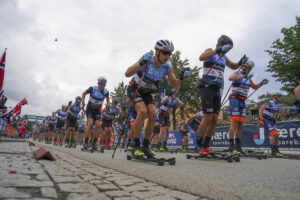
“Tactically, long races like Marcialonga are always stressful at the start. It is tight, and getting out well from the start is important without getting into problems. Here, many people fall and/or break poles,” says Anders Aukland, and he recalls that things calm down after the frantic start.
“Find the flow after the stress out of Moena city,” advises the Marcialonga veteran.
The article continues below.

From the start in Moena, it rises steadily up the Val di Fassa valley. The most challenging climbs come during the first few kilometers. Here there are several steep bends before the terrain flattens out a bit, and the climb becomes tougher until the town of Canazei, the highest point on the course. There is also the first of two sprint prizes. How you face this part of the trail will also be decisive for the rest of the race.
“It’s hard up to Canazei, but here it’s important to stick to a good group. If you manage that, you’ll get well down the valley. At the same time, you must also distribute your energies correctly because there is still a long way to go,” says Aukland.
Also Read: This Is How Marcialonga Revolutionized Long-Distance Skiing
The article continues below.

Canazei to Moena
After the turn in Canazei, the course changes its characteristics. From here, there are many manageable sections, high speed, and some slightly technical sections.
The easy sections are interrupted by a tougher section after the skiers return to the starting town of Moena: “Wall of Soraga” is a hill of only a few hundred meters, but it is steep and always ensures the field stretches out.
The following section afterward is winding and relatively flat. Then follows the fast and somewhat technically demanding descent down to the center of Moena. The speed is almost always high in this part, and the skiers use a lot of energy. The field will certainly break, but usually, it regroups again.
The article continues below.

Moena to Predazzo and the WC stadium
From Moena, where the skiers have previously turned towards Val di Fiemme, the course has been rerouted. Now the course goes down to Molina, where the skiers have another loop through the village before going back and towards Cavalese.
After Moena, it goes all the way down to Predazzo. Here is the race’s second sprint checkpoint. It is also the finish line for the shorter version of the race.
From Predazzo, the course changes again. From forest terrain along the river in the upper part of the track, the route is now mainly out on open fields. Here, the sun shines throughout the morning, and there is often a change in track and air temperatures that only increase the closer you get to the finish line.
The significant temperature changes during the race also mean that the skiers’ skis can change. Those who have had good skiing at the start can have trouble here, and vice versa. Most of those who go to win the race choose to wax their skis for the tracks that await them after Predazzo.
The article continues below.

WC Stadium to Molina
There is a sprint through the WC stadium in Val di Fiemme, on Lago di Tesero, and then the last part of the race begins. The course again becomes more winding and has several small, short bends. The favorites are starting to position themselves, and this is where you really want to see the outlines of who will fight for victory.
From the WC stadium down to the trail’s lowest point, on the bridge in Molina, it is 11 kilometers. The skiers have now been out for over two and a half hours. From here, the track changes in characteristics from going gently downhill to gently uphill.
“If you manage to keep up the pace from the WC stadium and in, there is a lot to be gained on this stretch,” says Aukland.
The critical point: Molina to Cascata
This is often the critical point where the battle for victory begins. The goal for those who want to win is to stay far ahead in the field, but preferably not at the very first. Many teams will try to make a move for their protected skier until the bottom of the Cascata.
“From Molina to the finish line, it’s hard. If you’re touring, enjoy it. If you have ambitions, this is where you must dig deep, both physically and mentally,” says Aukland.
The article continues below.

New Finish: Cascata to the finish line
Cascata, the notorious uphill with a 6.5% average gradient and 146 meters of height spread over just 2.2 kilometers, is now even steeper: the organizer has changed the course so that the skiers have to climb a total of 148 meters of height in an approximately 25 percent shorter stretch.
From 2023, the ascent shortens to 1678 meters, with 148 meters of difference in height and an average slope of 8.80%. At the hairpin turn where Rio Gambis flows, skiers change direction and go straight forward to deal with the “Mur de la Stria” (The Witch’s Wall), 583 meters with “just” 58 meters difference in height, with an average slope of 9.90%, reaching even 20%!
The biggest challenge, however, is the last 500 meters before the hill. The skiers have to cross a bridge and under a narrow and low underpass, and there is only room for one skier. This causes the field to stretch out. If you are, for example, in tenth place here, you will start the hill at least 30-40 meters behind the leader. It can be decisive for the outcome.
From this point, it is usually clear who wins: the one who manages to maintain the pace and speed and deals with the stretch to the finish in Cavalese. From the top of the “Mur de la Stria,” the skiers continue to Viale Mendini, where the finish line has been until now. But from 2023, there are still 140 meters to go before they cross the line and finish their 70 kilometers.
When the first skier crosses the finish line, a cannon shot is fired and can be heard throughout the valley.
The article continues below.

Historical
This year, Marcialonga is celebrating its 50th edition.
Marcialonga was organized for the first time in 1971, and only three times the race had to be canceled: 1975, 1989, and 1990. The lack of snow was the main reason for canceling the races.
Now the race organizer has invested in the industry’s most advanced snowmaking equipment. Earlier this autumn, the organizing committee guaranteed that the 70-kilometer-long classic race would be covered with snow and carried out regardless of natural snowfall.
The Season XIV of Ski Classics Pro Tour consists of 14 events on 10 event weekends in 6 different countries.
Ski Classics Pro Tour Season XIV (2022/2023)
- Event 1: December 10, 2022 – Bad Gastein PTT, Bad Gastein, Austria, 15km
- Event 2: December 11, 2022 – Bad Gastein Criterium, Bad Gastein, Austria, 35km
- Event 3: December 17, 2022 – La Venosta Criterium, Val Venosta, Italy, 36km
- Event 4: January 14, 2023 – Pustertaler Ski Marathon, Sexten, Italy, 62km
- Event 5: January 15, 2023 – Prato Piazza Mountain Challenge, Niederdorf, Italy, 32km
- Event 6: January 21, 2023 – Engadin La Diagonela, Engadin Valley, Switzerland, 48km
- Event 7: January 29, 2023 – Marcialonga, Trentino, Italy, 70km
- Event 8: February 12, 2023 – Jizerská50, Bedrichov, Czech Republic, 50km
- Event 9: February 18, 2023 – Grönklitt Criterium, Orsa Grönklitt, Sweden, 50km
- Event 10: February 19, 2023 – Grönklitt ITT, Orsa Grönklitt, Sweden, 15km
- Event 11: March 5, 2023 – Vasaloppet, Sälen-Mora, Sweden, 90km
- Event 12: March 18, 2023 – Birkebeinerrennet, Rena-Lillehammer, Norway, 54km
- Event 13: April 1, 2023 – Reistadløpet, Setermoen-Bardufoss, Norway, 40km
- Event 14: April 2, 2023 – Summit 2 Senja, Bardufoss- Finnsnes, Norway, 67km
More information about the Ski Classics Pro Tour you can find at skiclassics.com.
As a member of ProXCskiing.com, you get full access to all content on the site and live streaming of Ski Classics Pro Tour events with English commentaries.
When you become part of one of the world’s leading XC ski communities, you will receive many exclusive offers all year round.
Register HERE as a Member.
Subscribe to our newsletter
Most read
-
11.05.2026
-
23.08.2022
-
09.07.2026
-
03.08.2026
-
05.08.2026


More Articles
-
Never competed internationally – now he’s outshining the stars
Sturla Holm Lægreid is one of the world's most accurate biathletes, and Martin Uldal is among the fastest. None of them came close to Sivert Bjørndalen in his season debut.23.08.2026