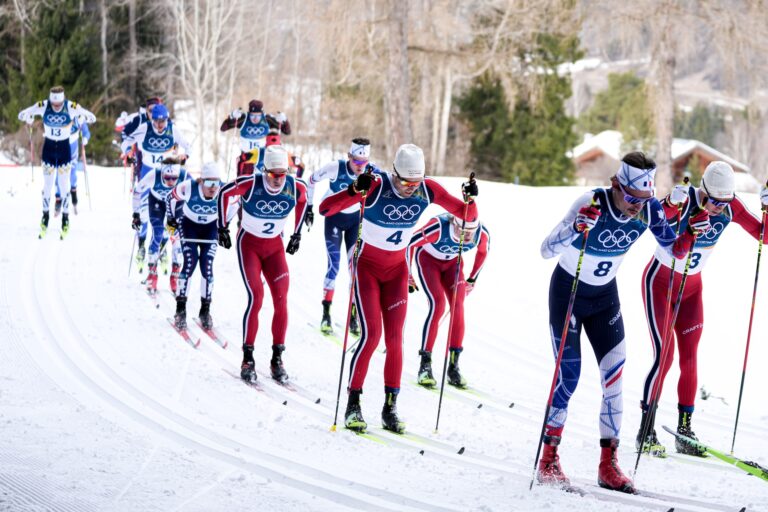
Technique expert warns: “For every centimeter of incorrect pole length, you lose time”

The technique expert warns at what he sees: “People are careless with poles. I don’t think they know how much it costs them.”
That’s what technique expert and Vasaloppet guru Erik Wickström says, believing many are unaware of the significance of poles and pole length, thus not spending enough time to find the right equipment.
Erik Wickström has authored several books on cross-country skiing and training, equipment, gives lectures, and is behind the podcast “Lagom Kondition” aimed at beginners and enthusiasts. He also offers training guidance to athletes at all levels (except elite competitors) through his company Wickström Coaching.
Wickström has participated in Vasaloppet several times, as well as other ski marathons, but he is also a technique and training advisor for cross-country skiers and enthusiasts at various levels. He is concerned about what he sees both in the racetracks and at his own technique and training sessions.
“People are terribly careless with poles. They spend a lot of time on skis and boots and other equipment, but it seems they don’t care much about poles,” says the experienced training advisor.
Wickström primarily points the finger at sports stores.
“Many retailers are really good at picking the right skis and ski boots for people, but when it comes to poles, it seems they lack knowledge and send people out with completely wrong equipment.”
There are particularly two issues that the experienced training advisor repeatedly sees.
“I see incredibly many with poles that are too short and with straps that are too large,” he says.

Discomfort and Frustration
Rushing and negligence in the pole length and incorrect strap size can cost you a lot in both time and enjoyment of skiing but can also lead to hand pain.
“I don’t think people realize how much they lose by having the wrong length of poles, especially too short poles,” says Wickström, elaborating:
“For every centimeter you reduce from the maximum pole length allowed by FIS, you lose a significant amount of time in double poling. For elite competitors and many of the most avid enthusiasts, double poling is all that matters in long-distance races, so for them, it matters even more. However, that group tends to have the correct pole length. But more and more people at lower levels are double poling more and more, so this affects everyone.”
The FIS maximum pole length is defined as your height in centimeters with ski boots on x 0.83.
“Some might feel that it is slightly harder to diagonal stride if the poles are up to the maximum limit, but that is very little compared to the benefit of the correct pole length in double poling,” Wickström adds.
Read also: The Big Ski Test 2023 – Ski Poles
The article continues below.

So, how long should the poles be in relation to body length?
“The maximum allowed pole length according to FIS’ rules actually tends to be quite perfect for most people. And that applies to both the elite and recreational. I see this time and time again when I run technique courses,” Wickström tells Langrenn.com.
Remember that the FIS maximum is calculated from where the strap is attached to the pole handle. This can vary between manufacturers. Many pole manufacturers now attach the strap just one centimeter from the top of the pole handle, but on some poles, the strap can be attached up to four centimeters below the top of the pole handle.
Therefore, it’s important to know if the pole length marked on the pole is measured from the tip to the top of the pole handle, or from the tip to where the strap is attached, whether it’s at the very top or a bit below the top. This will have implications for which pole you should buy to still get the correct length.
“A skilled retailer can pick the right pole length, but only if you emphasize that you want poles that are the maximum allowed length,” Wickström points out.
Read more: Why are the top poles so expensive?
Don’t Forget About the Straps
Not only the pole length is important when you are buying poles. Take some time to find the right size for the strap as well.
“The thing about pole straps is very individual. It’s not just about the size but also the shape of the strap. And I would say it’s even more individual than ski boots,” says Wickström.
Some have large hands, others have small. Some like to ski with the thinnest ski gloves, others prefer lobster gloves or mittens. This will influence what size the straps should be. But the wrong size of straps is a bad idea for several reasons.
“If you have the wrong size straps, you can get blisters on your hands, strain on hands and wrists, and you may experience an uncomfortable return on the pole pendulum where the pole does not fall back into your hand correctly after each pole stroke,” says Wickström, and continues:
“Often, the straps are too large. That means you must grip the pole throughout the entire pole stroke movement, and thus you unnecessarily tense your forearm at the end of the pole stroke, instead of being able to relax. I would say that more than half of those who have been on our courses have straps that are too large. I wear size 8 gloves but have straps in size S.”
Most manufacturers make straps in several sizes that can easily be swapped and used interchangeably. But don’t buy new or switch to unfamiliar straps the night before a long race, Wickström advises.
“If you’ve bought new poles or straps, it’s important to spend some time adjusting them correctly and making sure they fit and function exactly as they should. I would say you need at least one long training or more to be sure you have them as they should be.”

Subscribe to our newsletter
Most read
-
03.08.2026
-
-
26.07.2026
-
28.01.2026
-
14.09.2026


More Articles
-
Skiers embrace new trend: “Of course it’s interesting”
The trend has grown among cyclists, and now skiers are following suit.