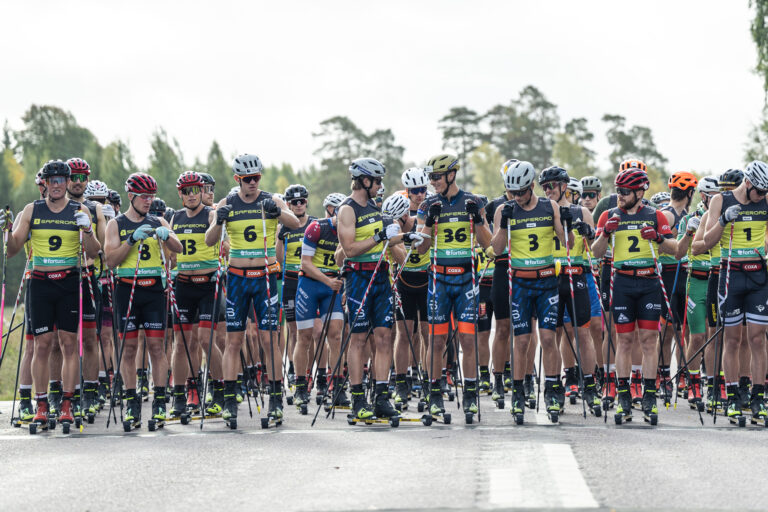
Are you tired of breaking your roller ski poles?

Many people install roller ski tips on competition poles they use in the winter. This leads to unnecessary pole breaks. Which poles should you choose for roller skis?
Summer is the time for roller skiing. A Swix pole manager lives close to one of Oslo’s most popular areas for roller ski training and daily sees many people roller skiing with the same poles used in winter.
“Don’t use your best carbon poles for roller ski training. When I see people roller skiing with Swix Triac Aero poles, I feel bad and wonder if they are aware that expensive competition poles for winter are not built to withstand roller skiing training,” says Pat Lam Thorstad, the head of pole product development at Swix.
Competition poles for winter use are not designed to withstand the stress that roller skiing training exposes them to.
“There is a risk of breaking your most expensive competition poles if they are used for roller skiing. They are not made for that,” says Lam Thorstad and adds:
“The lightest and most expensive carbon poles are made of so-called high modulus carbon fiber. They are very strong in the longitudinal direction, but the material is also very fragile, and they withstand little shock and stress from the side.”
Also Read: What should you consider when buying roller skis?
The article continues below.

Roller ski poles withstand more stress
Roller ski poles have a unique construction that makes them more break-proof and better prepared for the stress they are exposed to in summer.
However, that doesn’t mean you have to settle for heavy, lifeless aluminum poles in the summertime. In recent years, Swix has launched a separate series of poles for roller skis: Swix Roadline, developed especially for the demands of roller skiing.
Roller skis have their demands
Lam Thorstad explains several considerations to consider in developing roller ski poles. Roller ski poles are based on the same technology used on cross-country poles but have some unique properties that standard cross-country poles do not have.
Firstly, the course surface is much harder. Regular competition poles are designed for snow use, while roller ski training mainly occurs on asphalt.
In addition, you often come across areas with stones and gravel that can create scratches and notches in the pole, and it is easy to bump into curbs and pole stones, stick the spike in a maintenance hole cover, or other obstacles in the street.
All this exposes the pole to other types of stress than they are built for, especially in the form of blows from the side. Therefore, the entire roller ski pole must be built slightly differently than poles for use on snow.
“Roller ski poles are made to withstand more beatings and blows,” says Lam Thorstad to Langrenn.com.
The article continues below.

Must be manufactured differently
The roller ski poles are based on the same properties that make the winter poles good, i.e., they must be light, stiff, and strong, have a good pendulum, and give a good response from the ground, but are developed to withstand more external stress, especially from the side.
“The roller ski poles have a slightly different composition to the winter poles and a slightly different placement of carbon and reinforcements. This means that they become much stronger in summer weather while still being light and responsive,” says Lam Thorstad.
Furthermore, the roller ski poles are designed to prevent stress injuries in the elbows and shoulders, which many suffer from to a greater extent with roller skis than on snow.
“Also, roller ski poles dampen every blow you make against the asphalt. In short, roller ski poles are gentler on your body,” says the pole developer.
The article continues below.

Winter poles for roller skiing: Use cheaper poles
Although roller ski poles are recommended for roller skiing use, Lam Thorstad understands that people do not want to buy another set of poles but rather put roller ski tips on the competition poles they use in winter and leave it there.
“If you will use winter poles for roller skiing training, it is best not to take the most expensive carbon poles. Instead, choose poles in the Quantum 3, Quantum 4, and Quantum 5 series. They will withstand more poling and work better for roller skis than, for example, Triac Aero 4.0,” says the pole manager at Swix, adding that the top pole for snow is also very stiff and, therefore, not very well suited to the hard surface.
Lam Thorstad explains that cheaper poles are made of a lower carbon modulus and different glass fiber proportions. The more fiberglass the pole contains, the stronger it will be. The disadvantage is that it also becomes heavier, which is why the most expensive poles are made of 100 percent carbon. It is a little heavier but also more robust.
Don’t forget the tips
Roller ski training not only places greater demands on the pole to withstand more poling. Also, the basket and tips are built differently from those used in winter. The tips must be harder so that it “holds” to the surface and provides a good grip.
There is also no need for the basket, as there is no snow for the pole to sink into. Therefore, if you are going to competitions, there is a requirement for roller ski tips with baskets of at least 30mm in diameter to avoid injury.
But even though roller ski tips are more robust than standard baskets and tips for winter use, they sometimes break or fall off. Athletes can wear out many sets of roller ski tips during the summer season.
In the past, changing tips was a tedious task, but after the TBS system with replaceable tips, it is now easier than ever. You can switch tips and baskets with a click without having to deal with pole glue, a heat gun, or tools. This way, if damaged, you can easily change the tips during a roller skiing session.
Also, remember that the roller ski tips must be kept sharp to provide a good grip. Over time, the tips become worn and blunt, and then they need to be sharpened.

Are you interested in traditional cross-country and long-distance skiing equipment? Click HERE and read more.
Subscribe to our newsletter
Most read
-
03.08.2026
-
26.07.2026
-
28.01.2026
-
27.02.2026
-
25.08.2026



More Articles
-
Amund Riege and Stina Nilsson power to victory at Klarälvsloppet 2026
The Ski Classics Challengers event Klarälvsloppet, a 90km long-distance roller skiing race in classic technique, took place today in Karlstad, Sweden. Check out the results.20.09.2026